Number Guessing Game
Here is the code for the “Number Guessing Game” mini-project. It combines a while loop, the break statement, and basic if-elif-else conditions. Python How It Works:
Here is the code for the “Number Guessing Game” mini-project. It combines a while loop, the break statement, and basic if-elif-else conditions. Python How It Works:
In Python, break and continue are loop control statements. They allow you to alter the standard flow of a loop (whether a for loop or a while loop) based on specific conditions. Here is a detailed breakdown of how each statement works, along with examples. The break Statement The break statement is used to completely…
A for loop in Python is used to iterate over a sequence (such as a list, tuple, dictionary, set, or string) or any other iterable object. Unlike a while loop that runs as long as a condition is true, a for loop runs a specific number of times—once for each item in the sequence. The…
A while loop in Python is used to repeatedly execute a block of code as long as a given condition remains True. It is particularly useful when you don’t know beforehand how many times the loop needs to run. Before every iteration, Python evaluates the condition. If it evaluates to True, the code inside the…
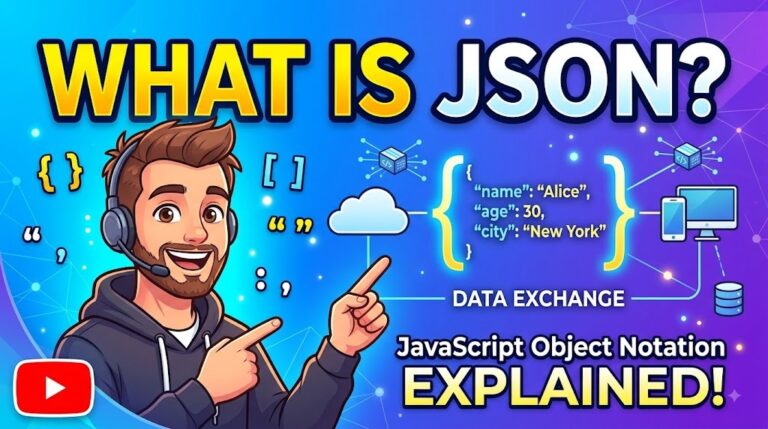
What is JSON? JSON stands for JavaScript Object Notation. It is a lightweight, text-based data interchange format designed to be easy for humans to read and write, and simple for machines to parse and generate. Although derived from a subset of JavaScript’s object syntax, JSON is completely language-independent. Virtually every modern programming language (Python, Java,…
Class Notes: Introduction to REST 1. Core Definition Key Takeaway: REST is a design pattern, not a strict protocol. 2. Protocol vs. Design Pattern To understand REST, it is crucial to understand the difference between a protocol and a design pattern: 3. The 6 Principles of REST Roy Fielding outlined six specific design patterns for…
In n8n, a workflow is a visual canvas where you connect different applications, APIs, and logic functions to automate a specific process. It represents the step-by-step instructions that tell n8n how to move and manipulate data from one point to another without human intervention. Core Components of a Workflow Every workflow in n8n is built…
Let’s build The Magic 8-Ball! A Magic 8-Ball is a fun toy where you ask it a “yes or no” question, shake it, and it gives you a random answer about the future. We can build our own digital version using the if, elif, and else statements you just learned. To make the answer a…
In Python, conditional statements allow your program to make decisions based on certain conditions. They control the flow of your code, ensuring that specific blocks run only if a condition is true. The three main keywords used are: Here are 10 examples showing how to use if, elif, and else in Python: 1. A Basic…
In Python, comparison operators are used to compare two values. They evaluate the relationship between the values and always return a Boolean result: either True or False. Here are the primary comparison operators in Python, along with >= (greater than or equal to) and <= (less than or equal to), demonstrated through 10 practical examples:…