🚀 *Gen AI Engineer (Production Focused)*
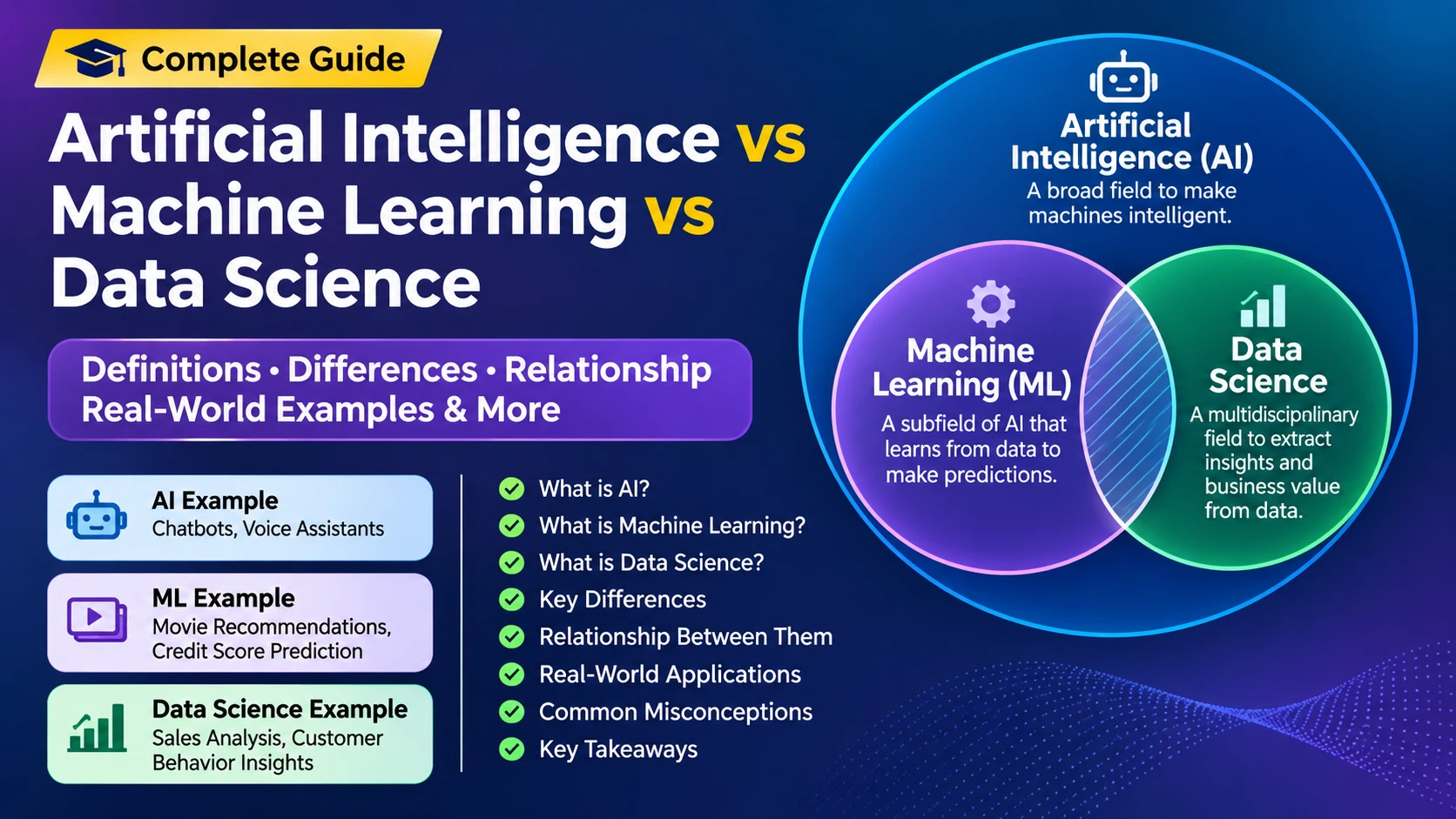
Artificial Intelligence vs Machine Learning vs Data Science – Complete Class Notes
1. Introduction
In the field of technology, we frequently come across three important terms:
- Artificial Intelligence (AI)
- Machine Learning (ML)
- Data Science
These terms are closely related and are sometimes used interchangeably. However, they do not have the same meaning.
Understanding the differences between AI, Machine Learning, and Data Science is essential for anyone who wants to build a career in Artificial Intelligence, Generative AI, Data Science, or Machine Learning.
In this lesson, we will understand each concept, how they are connected, and how they are used in real-world applications.
2. What Is Artificial Intelligence (AI)?
Artificial Intelligence (AI) is a broad field of computer science that focuses on making machines and computer systems intelligent enough to perform tasks that normally require human intelligence.
The primary goal of AI is to enable machines to perform tasks such as:
- Learning from information and experience.
- Understanding human language.
- Recognizing images and objects.
- Solving problems.
- Making decisions.
- Identifying patterns.
- Acquiring new skills and improving performance.
Real-World Examples of AI
Example 1: Voice Assistants
Applications such as Siri, Alexa, and Google Assistant can understand voice commands and respond to user questions.
Example 2: Chatbots
AI-powered chatbots can understand user questions and generate appropriate responses.
Example 3: Self-Driving Cars
AI systems help autonomous vehicles understand their surroundings, identify obstacles, and make driving decisions.
Example 4: Face Recognition
AI-powered systems can identify and recognize faces from images or video streams.
Important Point
Artificial Intelligence is a broad discipline that includes several subfields and techniques. Machine Learning is one of the most important subfields of AI.
3. What Is Machine Learning (ML)?
Machine Learning (ML) is a subfield of Artificial Intelligence that enables computers to learn patterns and relationships from data and use what they have learned to make predictions or decisions.
Instead of explicitly programming a computer with every possible rule, we provide data to a Machine Learning algorithm. The algorithm learns patterns from that data and builds a model.
The trained model can then process new input data and produce an output.
How Does Machine Learning Work?
We can understand Machine Learning using a simple mathematical function.
Consider a function:
Output = f(Input)
In Machine Learning:
- We provide input data to a Machine Learning model.
- The model processes the input using patterns learned during training.
- The model generates an output.
- We use that output to make predictions or support decisions.
Basic Machine Learning Process
Input Data → ML Model → Prediction / Output
For example:
- Input: Customer details and financial history.
- ML Model: A trained credit risk prediction model.
- Output: An estimate of the customer’s likelihood of repaying a loan.
The model learns from historical data and applies those learned patterns to new customer information.
Real-World Examples of Machine Learning
Example 1: Movie Recommendation System
Imagine you regularly watch movies on a streaming platform.
The platform can analyze your movie-watching history, including:
- Movies you have watched.
- Genres you prefer.
- Movies you have rated.
- Your viewing patterns.
- Similar users’ preferences.
A Machine Learning algorithm identifies patterns in this information and predicts which movies you might enjoy watching next.
Input: User’s movie-watching history.
Processing: Machine Learning model identifies patterns and preferences.
Output: Recommended movies.
This is how movie recommendation systems provide personalized suggestions.
Example 2: Credit Score Prediction
Banks and financial institutions need to evaluate whether a customer is likely to repay a loan.
They can use historical financial information such as:
- Previous loan repayment history.
- Monthly income.
- Existing loans.
- Credit card repayment history.
- Outstanding debts.
- Financial transaction records.
A Machine Learning model analyzes these details and estimates the customer’s credit risk or likelihood of repaying a loan.
Input: Customer’s financial information.
Processing: Machine Learning model analyzes historical patterns.
Output: Credit risk prediction or an estimated credit score, depending on the system.
This helps financial institutions make more informed lending decisions.
Important Points About Machine Learning
- Machine Learning is a significant branch of Artificial Intelligence.
- It uses data to identify patterns and relationships.
- It builds models using historical data.
- Trained models can make predictions on new data.
- The quality and relevance of training data can significantly influence model performance.
Remember: Machine Learning is not simply about storing data. It is about learning useful patterns from data and applying them to new situations.
4. What Is Data Science?
Data Science is a multidisciplinary field that combines mathematics, statistics, programming, data analysis, Machine Learning, and data visualization to extract meaningful insights and business value from data.
The main objective of Data Science is to understand data, discover useful information, identify trends, and support better business decisions.
Data Science uses Artificial Intelligence and Machine Learning techniques, but it does not depend entirely on them.
Data Scientists also use traditional statistical methods and analytical techniques to understand data.
Major Areas of Data Science
Data Science commonly involves:
- Mathematics: Mathematical concepts used to understand data and develop analytical models.
- Statistics: Techniques used to analyze data, identify patterns, and draw conclusions.
- Programming: Languages such as Python and SQL used to collect, process, and analyze data.
- Data Visualization: Presenting data through charts, graphs, and dashboards.
- Machine Learning: Developing models to predict outcomes and identify patterns.
- Business Understanding: Converting data analysis results into useful business decisions.
Example: Understanding Customer Orders
Imagine a retail company wants to understand its customer purchasing behavior.
A Data Scientist can collect and analyze information such as:
- Customer orders.
- Store visits.
- Product sales.
- Customer locations.
- Purchase frequency.
- Monthly revenue.
The Data Scientist can use different techniques to gain business insights.
Approach 1: Data Visualization
The Data Scientist can create a chart comparing the number of customer orders with the number of store visits.
For example:
| Store Visits | Customer Orders |
|---|---|
| 100 | 30 |
| 200 | 65 |
| 300 | 105 |
| 400 | 145 |
| 500 | 190 |
By plotting these values on a chart, the company may identify a relationship between store visits and customer orders.
This insight can help the business understand customer behavior and improve marketing strategies.
Important: A relationship shown in a chart does not automatically prove that one factor causes the other.
Approach 2: Statistical Analysis
A Data Scientist can use statistical techniques to:
- Calculate averages.
- Identify trends.
- Measure variation.
- Compare different customer groups.
- Perform statistical hypothesis testing.
- Draw conclusions from sample data.
These methods help businesses understand what is happening in their operations.
Approach 3: Machine Learning Prediction
The Data Scientist can also develop a Machine Learning model using historical customer order information.
The model can learn patterns from previous orders and predict the number of orders the company might receive in the future.
Input: Historical customer order data and other relevant business information.
Processing: Machine Learning model identifies patterns.
Output: Predicted future customer orders.
Important Point
Data Science is not limited to Machine Learning. A Data Scientist can generate valuable business insights using statistics, mathematics, and data visualization without building an ML model.
5. Relationship Between AI, Machine Learning, and Data Science
Artificial Intelligence, Machine Learning, and Data Science are closely connected, but their objectives and approaches are different.
AI and Machine Learning Relationship
- Artificial Intelligence is the broader field.
- Machine Learning is one of the important subfields of AI.
- Machine Learning helps AI systems learn patterns from data and make predictions or decisions.
Relationship:
Artificial Intelligence → Machine Learning
Machine Learning is part of Artificial Intelligence, but not every AI technique necessarily uses Machine Learning.
Data Science and Machine Learning Relationship
Data Science uses Machine Learning as one of its important techniques.
However, Data Science also includes:
- Mathematics.
- Statistics.
- Data Analysis.
- Data Visualization.
- Business Intelligence.
- Data Interpretation.
A Data Scientist may use Machine Learning to predict future outcomes or use traditional statistical analysis to understand existing business performance.
Conceptual Relationship
Think of the three fields this way:
- AI: Focuses on building systems that perform tasks associated with intelligence.
- Machine Learning: Focuses on enabling systems to learn patterns from data.
- Data Science: Focuses on extracting meaningful insights and business value from data.
AI and Data Science overlap through Machine Learning and other analytical techniques, but they are not the same discipline.
6. Difference Between AI, Machine Learning, and Data Science
| Comparison | Artificial Intelligence | Machine Learning | Data Science |
|---|---|---|---|
| Meaning | A broad field focused on intelligent machines | A subfield of AI that learns from data | A field focused on extracting insights from data |
| Main Goal | Build intelligent systems | Learn patterns and make predictions | Discover insights and support decisions |
| Focus | Intelligence and decision-making | Data-driven learning | Data analysis and business value |
| Uses Data | Yes, depending on the approach | Yes, to train models | Yes, as its primary resource |
| Techniques | ML, reasoning, search, and other AI methods | Algorithms and statistical learning methods | Statistics, visualization, ML, and analysis |
| Example | Intelligent virtual assistant | Movie recommendation model | Customer behavior analysis |
7. Practical Business Scenario: Retail Company
Let’s understand all three concepts through a single real-world business scenario.
Imagine an online shopping company wants to improve customer experience and increase sales.
Artificial Intelligence
The company develops an intelligent chatbot that can understand customer questions and provide responses about products, orders, and deliveries.
Goal: Provide intelligent customer support.
Machine Learning
The company develops a recommendation model that analyzes customers’ previous purchases and predicts which products they may be interested in buying next.
Goal: Predict customer preferences and recommend relevant products.
Data Science
The company’s Data Scientist analyzes sales data, customer visits, product performance, and revenue using statistical methods and visualization.
The Data Scientist identifies which products are performing well and which marketing campaigns generate more sales.
Goal: Extract business insights and support better decisions.
Summary of This Scenario
| Technology | Business Application |
|---|---|
| AI | Intelligent customer support chatbot |
| Machine Learning | Personalized product recommendations |
| Data Science | Sales analysis and business insights |
This example demonstrates how AI, Machine Learning, and Data Science can work together within the same organization.
8. Common Misconceptions
Misconception 1: AI and Machine Learning Are the Same
Reality: AI is a broader discipline, whereas Machine Learning is one of its subfields.
Misconception 2: Machine Learning and Data Science Are the Same
Reality: Machine Learning is a technique used in Data Science. Data Science also includes statistics, mathematics, data visualization, and business analysis.
Misconception 3: Every Data Science Task Requires Machine Learning
Reality: Some Data Science tasks can be completed using traditional statistical methods, SQL queries, data analysis, and visualization without using Machine Learning.
Misconception 4: Data Visualization Is Not Part of Data Science
Reality: Data visualization is an important part of Data Science because it helps communicate patterns, trends, and insights effectively.
9. Key Takeaways
- Artificial Intelligence (AI) is a broad discipline that aims to make machines perform tasks associated with human intelligence.
- Machine Learning (ML) is a major subfield of AI that uses data to learn patterns and make predictions or decisions.
- Data Science combines mathematics, statistics, programming, data visualization, and Machine Learning to extract useful insights from data.
- Machine Learning models generally receive input data, process it using learned patterns, and generate an output.
- Movie recommendations and credit risk predictions are practical examples of Machine Learning.
- Data Scientists use both Machine Learning and traditional statistical methods.
- Data visualization helps identify trends and relationships in business data.
- A Data Science project does not always require a Machine Learning model.
- AI, Machine Learning, and Data Science are different but interconnected fields.
10. Frequently Asked Questions (FAQs)
1. Is Machine Learning part of Artificial Intelligence?
Yes. Machine Learning is one of the major subfields of Artificial Intelligence. It enables systems to learn patterns from data and make predictions or decisions.
2. Is Data Science part of AI?
Not exactly. Data Science is a separate multidisciplinary field that overlaps with AI and Machine Learning. It also includes statistics, mathematics, programming, and data visualization.
3. Can we perform Data Science without Machine Learning?
Yes. We can perform many Data Science tasks using SQL, Python, statistics, data analysis, and visualization without developing any Machine Learning models.
4. What is the main difference between AI and ML?
AI focuses on building intelligent systems, whereas ML focuses on enabling systems to learn from data.
5. Can a Data Scientist work with Machine Learning?
Yes. Machine Learning is an important skill in many Data Science roles. Data Scientists often use ML algorithms to build predictive models and solve business problems.
6. What is an example of Machine Learning in daily life?
Movie recommendations, product recommendations, email spam detection, fraud detection, and credit risk prediction are common examples of Machine Learning applications.
11. Conclusion
Artificial Intelligence, Machine Learning, and Data Science are closely related technologies that play important roles in modern businesses.
Artificial Intelligence focuses on creating intelligent systems. Machine Learning enables systems to learn patterns from data and make predictions. Data Science uses mathematics, statistics, programming, visualization, and Machine Learning to extract valuable information from data.
Understanding these differences provides a strong foundation for learning Machine Learning, Generative AI, and other advanced AI technologies.
Remember these three definitions:
- AI: Making machines intelligent.
- Machine Learning: Teaching machines to learn patterns from data.
- Data Science: Extracting meaningful insights and business value from data.
Artificial Intelligence vs Machine Learning vs Data Science – పూర్తి వివరణ
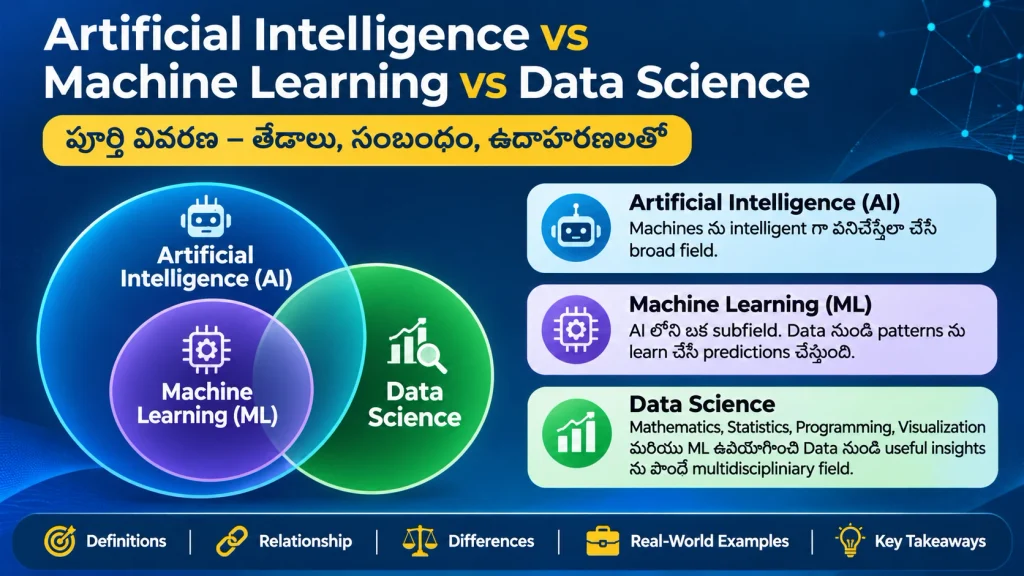
1. Introduction
Technology రంగంలో మనం తరచుగా మూడు ముఖ్యమైన terms గురించి వింటూ ఉంటాము.
- Artificial Intelligence (AI)
- Machine Learning (ML)
- Data Science
ఈ మూడు concepts ఒకదానితో ఒకటి closely related గా ఉంటాయి. కొన్ని సందర్భాల్లో వీటిని ఒకే అర్థంలో ఉపయోగిస్తుంటారు. అయితే, ఈ మూడింటికీ వేర్వేరు meanings మరియు purposes ఉన్నాయి.
Artificial Intelligence, Machine Learning, Data Science మధ్య ఉన్న differences తెలుసుకోవడం చాలా ముఖ్యం. ముఖ్యంగా Artificial Intelligence, Generative AI, Machine Learning లేదా Data Science రంగాల్లో career ప్రారంభించాలనుకునే వారికి ఈ concepts పై మంచి understanding ఉండాలి.
ఈ lesson లో మనం ఒక్కొక్క concept గురించి, వాటి మధ్య ఉన్న relationship గురించి మరియు real-world applications గురించి తెలుసుకుందాం.
2. What Is Artificial Intelligence (AI)?
Artificial Intelligence (AI) అనేది Computer Science లోని ఒక broad field. సాధారణంగా మనుషులు తమ intelligence ఉపయోగించి చేసే పనులను computers మరియు machines ద్వారా చేయించడమే AI యొక్క ముఖ్యమైన లక్ష్యం.
AI ద్వారా machines కొన్ని human intelligence related tasks చేయగలుగుతాయి.
ఉదాహరణకు:
- Information మరియు experience ఆధారంగా Learning చేయడం.
- Human Language ను అర్థం చేసుకోవడం.
- Images మరియు Objects ను Recognize చేయడం.
- Problems ను Solve చేయడం.
- Decisions తీసుకోవడం.
- Data లో Patterns ను Identify చేయడం.
- కొత్త Skills నేర్చుకోవడం మరియు Performance ను Improve చేసుకోవడం.
Real-World Examples of AI
Example 1: Voice Assistants
Siri, Alexa, Google Assistant వంటి applications Voice Commands ను అర్థం చేసుకుని, వాటికి తగిన Responses ఇస్తాయి.
ఉదాహరణకు, మనం Google Assistant ను “What is the weather today?” అని అడిగితే, అది మన ప్రశ్నను అర్థం చేసుకుని Weather Information అందిస్తుంది.
Example 2: Chatbots
AI-powered Chatbots User అడిగిన Questions ను అర్థం చేసుకుని, వాటికి సంబంధించిన Answers Generate చేయగలవు.
ఉదాహరణకు, ఒక Banking Chatbot ద్వారా Account Balance, Transaction Details మరియు Banking Services గురించి తెలుసుకోవచ్చు.
Example 3: Self-Driving Cars
AI Systems ఉపయోగించి Self-Driving Cars తమ పరిసరాలను అర్థం చేసుకుంటాయి.
అవి:
- Road Signs ను Identify చేస్తాయి.
- ఇతర Vehicles ను Detect చేస్తాయి.
- Pedestrians ను Recognize చేస్తాయి.
- Obstacles ను Identify చేస్తాయి.
- Driving Decisions తీసుకుంటాయి.
Example 4: Face Recognition
AI-powered Face Recognition Systems Images లేదా Video Streams లో ఉన్న Faces ను Recognize చేయగలవు.
ఉదాహరణకు, మనం Smartphone Unlock చేయడానికి ఉపయోగించే Face Recognition ఒక practical application.
Important Point
Artificial Intelligence అనేది చాలా పెద్ద discipline. ఇందులో Machine Learning వంటి అనేక Subfields మరియు Techniques ఉంటాయి.
Machine Learning అనేది Artificial Intelligence లోని అత్యంత ముఖ్యమైన Subfields లో ఒకటి.
3. What Is Machine Learning (ML)?
Machine Learning (ML) అనేది Artificial Intelligence లోని ఒక Subfield. ఇది Data నుండి Patterns మరియు Relationships ను Learn చేసుకుని, వాటి ఆధారంగా Predictions లేదా Decisions చేయడానికి computers కు సహాయపడుతుంది.
సాధారణ Programming లో ప్రతి task కోసం మనం Computer కు Instructions లేదా Rules ఇవ్వాలి.
కానీ Machine Learning లో ప్రతి possible situation కు మనమే Rules రాయాల్సిన అవసరం ఉండదు.
దానికి బదులుగా, మనం Historical Data ను Machine Learning Algorithm కు అందిస్తాము. ఆ Data ను Analyze చేసి, అందులోని Patterns ను Identify చేసుకుని ఒక Model ను Build చేస్తుంది.
తర్వాత Train అయిన Model కొత్త Input Data ను Process చేసి Output లేదా Prediction ను Generate చేస్తుంది.
How Does Machine Learning Work?
Machine Learning ను ఒక simple Mathematical Function ద్వారా అర్థం చేసుకోవచ్చు.
Output = f(Input)
Machine Learning లో కూడా ఇదే Concept ఉపయోగించబడుతుంది.
- ముందుగా మనం Machine Learning Model కు Input Data ను Provide చేస్తాము.
- Model Training సమయంలో నేర్చుకున్న Patterns ఆధారంగా Input ను Process చేస్తుంది.
- Model ఒక Output ను Generate చేస్తుంది.
- ఆ Output ను ఉపయోగించి Predictions లేదా Decisions తీసుకోవచ్చు.
Basic Machine Learning Process
Input Data → ML Model → Prediction / Output
ఉదాహరణకు:
- Input: Customer Details మరియు Financial History.
- Processing: Trained Credit Risk Prediction Model ఆ Information ను Analyze చేస్తుంది.
- Output: Customer Loan Repayment చేసే అవకాశాన్ని Estimate చేస్తుంది.
ఇలా Historical Data లోని Patterns ను నేర్చుకుని, కొత్త Customer Information పై Predictions చేయగలుగుతుంది.
Real-World Examples of Machine Learning
Example 1: Movie Recommendation System
మీరు ఒక Online Streaming Platform లో Movies చూస్తున్నారని అనుకుందాం.
మీరు ఏ Movies చూస్తున్నారు, ఏ Genres ఇష్టపడుతున్నారు అనే Information ను Platform Analyze చేస్తుంది.
ఉదాహరణకు:
- మీరు ఇప్పటివరకు చూసిన Movies.
- మీకు నచ్చిన Movie Genres.
- మీరు Movies కు ఇచ్చిన Ratings.
- మీ Viewing Patterns.
- మీలాంటి Preferences ఉన్న ఇతర Users యొక్క Movie Choices.
ఈ Information ను Machine Learning Algorithm Analyze చేసి, మీ Preferences కు సంబంధించిన Patterns ను Identify చేస్తుంది.
ఆ Patterns ఆధారంగా మీరు తర్వాత ఏ Movies చూడడానికి ఆసక్తి చూపిస్తారో Predict చేస్తుంది.
Input: User యొక్క Movie Watching History.
Processing: Machine Learning Model Patterns మరియు Preferences ను Identify చేస్తుంది.
Output: User కు నచ్చే అవకాశం ఉన్న Movies ను Recommend చేస్తుంది.
ఈ విధంగా Streaming Platforms ప్రతి User కు Personalized Movie Recommendations అందిస్తాయి.
Example 2: Credit Score Prediction
Banks మరియు Financial Institutions ఒక Customer కు Loan ఇవ్వడానికి ముందు, ఆ Customer Loan ను తిరిగి Repay చేయగలరా లేదా అనే విషయాన్ని Evaluate చేయాలి.
దీని కోసం Customer కు సంబంధించిన Historical Financial Information ను ఉపయోగించవచ్చు.
ఉదాహరణకు:
- Previous Loan Repayment History.
- Monthly Income.
- Existing Loans.
- Credit Card Repayment History.
- Outstanding Debts.
- Financial Transaction Records.
Machine Learning Model ఈ Information ను Analyze చేసి, Customer యొక్క Credit Risk లేదా Loan Repayment చేసే అవకాశాన్ని Estimate చేస్తుంది.
Input: Customer Financial Information.
Processing: Machine Learning Model Historical Patterns ను Analyze చేస్తుంది.
Output: Credit Risk Prediction లేదా సంబంధిత System ఆధారంగా Estimated Credit Score.
ఈ Predictions ఆధారంగా Financial Institutions మరింత సమర్థవంతమైన Lending Decisions తీసుకోవచ్చు.
Important Points About Machine Learning
- Machine Learning అనేది Artificial Intelligence లో ఒక ముఖ్యమైన Branch.
- ఇది Data ఉపయోగించి Patterns మరియు Relationships ను Identify చేస్తుంది.
- Historical Data ఉపయోగించి Models ను Build చేస్తుంది.
- Trained Models కొత్త Data పై Predictions చేయగలవు.
- Training Data Quality మరియు Relevance అనేవి Model Performance పై ప్రభావం చూపిస్తాయి.
Remember: Machine Learning అంటే Data ను Store చేయడం మాత్రమే కాదు. Data లోని Useful Patterns ను Learn చేసుకుని, కొత్త Situations లో వాటిని ఉపయోగించడం.
4. What Is Data Science?
Data Science అనేది Mathematics, Statistics, Programming, Data Analysis, Machine Learning మరియు Data Visualization వంటి అనేక Fields ను Combine చేసే ఒక Multidisciplinary Field.
దీని ముఖ్యమైన లక్ష్యం Data నుండి Meaningful Insights ను Extract చేయడం మరియు వాటి ద్వారా Business Value ను Generate చేయడం.
Data Science ద్వారా మనం Data ను Understand చేయవచ్చు, Useful Information ను Discover చేయవచ్చు, Trends ను Identify చేయవచ్చు మరియు Better Business Decisions తీసుకోవచ్చు.
Data Science లో Artificial Intelligence మరియు Machine Learning ముఖ్యమైన పాత్ర పోషిస్తాయి. అయితే Data Science పూర్తిగా Machine Learning పైనే ఆధారపడదు.
Data Scientists సాధారణ Statistical Methods మరియు Analytical Techniques ను కూడా ఉపయోగిస్తారు.
Major Areas of Data Science
Data Science లో సాధారణంగా ఈ క్రింది areas ఉంటాయి.
1. Mathematics
Data ను Understand చేయడానికి మరియు Analytical Models ను Develop చేయడానికి అవసరమైన Mathematical Concepts ఉపయోగిస్తారు.
2. Statistics
Data ను Analyze చేయడానికి, Patterns ను Identify చేయడానికి మరియు Conclusions తీసుకోవడానికి Statistical Techniques ఉపయోగిస్తారు.
3. Programming
Data ను Collect, Process మరియు Analyze చేయడానికి Python, SQL వంటి Programming Languages ఉపయోగిస్తారు.
4. Data Visualization
Charts, Graphs మరియు Dashboards ద్వారా Data ను Visual Representation రూపంలో చూపిస్తారు.
5. Machine Learning
Predictions చేయడానికి మరియు Data లోని Patterns ను Identify చేయడానికి Machine Learning Algorithms ఉపయోగిస్తారు.
6. Business Understanding
Data Analysis ద్వారా వచ్చిన Results ను Useful Business Decisions గా మార్చడం.
Example: Understanding Customer Orders
ఒక Retail Company తన Customers Purchasing Behavior ను అర్థం చేసుకోవాలనుకుంటోంది అనుకుందాం.
దీని కోసం Data Scientist ఈ క్రింది Information ను Collect మరియు Analyze చేయవచ్చు.
- Customer Orders.
- Store Visits.
- Product Sales.
- Customer Locations.
- Purchase Frequency.
- Monthly Revenue.
ఈ Data ద్వారా Business కు ఉపయోగపడే Insights ను పొందడానికి Data Scientist వివిధ Techniques ను ఉపయోగిస్తారు.
Approach 1: Data Visualization
Data Scientist Customer Orders మరియు Store Visits మధ్య ఉన్న Relationship ను ఒక Chart రూపంలో చూపించవచ్చు.
ఉదాహరణకు:
| Store Visits | Customer Orders |
|---|---|
| 100 | 30 |
| 200 | 65 |
| 300 | 105 |
| 400 | 145 |
| 500 | 190 |
ఈ Values ను Chart లో Plot చేయడం ద్వారా Store Visits పెరిగేకొద్దీ Customer Orders కూడా పెరుగుతున్నాయా లేదా అనే విషయం గమనించవచ్చు.
ఈ Information ద్వారా Company Customer Behavior ను అర్థం చేసుకుని Marketing Strategies ను Improve చేసుకోవచ్చు.
Important: Chart లో రెండు Variables మధ్య Relationship కనిపించినంత మాత్రాన, ఒక Variable మరొక Variable కు కారణం అని నిరూపించినట్లు కాదు.
Approach 2: Statistical Analysis
Data Scientist Statistical Techniques ఉపయోగించి ఈ క్రింది పనులు చేయవచ్చు.
- Averages Calculate చేయడం.
- Trends ను Identify చేయడం.
- Variations ను Measure చేయడం.
- Different Customer Groups ను Compare చేయడం.
- Statistical Hypothesis Testing చేయడం.
- Sample Data ఆధారంగా Conclusions తీసుకోవడం.
ఈ Statistical Methods ద్వారా Company తన Business Operations లో ఏమి జరుగుతుందో అర్థం చేసుకోవచ్చు.
Approach 3: Machine Learning Prediction
Data Scientist Historical Customer Order Information ను ఉపయోగించి ఒక Machine Learning Model ను Develop చేయవచ్చు.
ఈ Model Previous Orders లోని Patterns ను Learn చేసుకుని, Future లో Company కి ఎన్ని Orders రావచ్చో Predict చేయగలదు.
Input: Historical Customer Order Data మరియు ఇతర Relevant Business Information.
Processing: Machine Learning Model Data లోని Patterns ను Identify చేస్తుంది.
Output: Future Customer Orders Prediction.
Important Point
Data Science అనేది Machine Learning కు మాత్రమే పరిమితం కాదు.
Statistics, Mathematics మరియు Data Visualization ఉపయోగించి కూడా Data Scientist విలువైన Business Insights ను Generate చేయగలరు.
అంటే, ప్రతి Data Science Task కోసం Machine Learning Model ను Develop చేయాల్సిన అవసరం లేదు.
5. Relationship Between AI, Machine Learning, and Data Science
Artificial Intelligence, Machine Learning మరియు Data Science ఒకదానితో మరొకటి Closely Connected గా ఉంటాయి.
అయితే వీటి Objectives మరియు Working Approaches వేర్వేరుగా ఉంటాయి.
AI and Machine Learning Relationship
- Artificial Intelligence అనేది ఒక Broad Field.
- Machine Learning అనేది Artificial Intelligence లోని ఒక Important Subfield.
- Machine Learning ద్వారా AI Systems Data నుండి Patterns ను Learn చేసుకుని Predictions లేదా Decisions చేయగలవు.
Relationship:
Artificial Intelligence → Machine Learning
Machine Learning అనేది AI లో ఒక భాగం. అయితే ప్రతి AI Technique తప్పనిసరిగా Machine Learning ను ఉపయోగించాల్సిన అవసరం లేదు.
Data Science and Machine Learning Relationship
Data Science లో Machine Learning ఒక Important Technique గా ఉపయోగించబడుతుంది.
కానీ Data Science లో Machine Learning మాత్రమే ఉండదు.
ఇందులో ఈ క్రింది Concepts కూడా ఉంటాయి.
- Mathematics.
- Statistics.
- Data Analysis.
- Data Visualization.
- Business Intelligence.
- Data Interpretation.
ఒక Data Scientist Machine Learning ఉపయోగించి Future Outcomes ను Predict చేయవచ్చు.
అలాగే Traditional Statistical Analysis ఉపయోగించి Existing Business Performance ను Understand చేయవచ్చు.
Conceptual Relationship
ఈ మూడు Fields ను ఈ విధంగా అర్థం చేసుకోవచ్చు.
AI:
Intelligence కు సంబంధించిన Tasks ను Perform చేసే Intelligent Systems ను Build చేయడంపై Focus చేస్తుంది.
Machine Learning:
Data నుండి Patterns ను Learn చేసుకుని Predictions లేదా Decisions చేయడంపై Focus చేస్తుంది.
Data Science:
Data నుండి Meaningful Insights మరియు Business Value ను Extract చేయడంపై Focus చేస్తుంది.
AI మరియు Data Science మధ్య Machine Learning మరియు ఇతర Analytical Techniques ద్వారా Overlap ఉంటుంది. అయినప్పటికీ ఈ రెండూ ఒకటే కాదు.
6. Difference Between AI, Machine Learning, and Data Science
ఈ మూడు Concepts మధ్య ఉన్న Differences ను ఈ క్రింది Table ద్వారా అర్థం చేసుకుందాం.
| Comparison | Artificial Intelligence | Machine Learning | Data Science |
|---|---|---|---|
| Meaning | Intelligent Machines ను Develop చేసే Broad Field | Data నుండి Learn చేసుకునే AI Subfield | Data నుండి Insights ను Extract చేసే Field |
| Main Goal | Intelligent Systems ను Build చేయడం | Patterns ను Learn చేసి Predictions చేయడం | Insights Discover చేసి Business Decisions కు Support చేయడం |
| Focus | Intelligence మరియు Decision-making | Data-driven Learning | Data Analysis మరియు Business Value |
| Uses Data | Yes, Approach ఆధారంగా ఉంటుంది | Yes, Models Train చేయడానికి | Yes, ఇది Primary Resource |
| Techniques | ML, Reasoning, Search మరియు ఇతర AI Techniques | Algorithms మరియు Statistical Learning Methods | Statistics, Visualization, ML మరియు Data Analysis |
| Example | Intelligent Virtual Assistant | Movie Recommendation Model | Customer Behavior Analysis |
7. Practical Business Scenario: Retail Company
ఇప్పటివరకు మనం AI, Machine Learning మరియు Data Science గురించి విడివిడిగా తెలుసుకున్నాం.
ఇప్పుడు ఒకే Business Scenario ద్వారా ఈ మూడు Technologies ఎలా ఉపయోగపడతాయో తెలుసుకుందాం.
ఒక Online Shopping Company తన Customer Experience ను Improve చేసి, Sales ను Increase చేయాలనుకుంటోంది అనుకుందాం.
Artificial Intelligence
Company ఒక Intelligent Chatbot ను Develop చేస్తుంది.
ఈ Chatbot Customer అడిగే Questions ను Understand చేసి Products, Orders మరియు Deliveries గురించి Responses అందిస్తుంది.
Goal: Intelligent Customer Support అందించడం.
Machine Learning
Company తన Customers యొక్క Previous Purchases ను Analyze చేసే ఒక Recommendation Model ను Develop చేస్తుంది.
ఈ Model Customer గతంలో ఏ Products కొనుగోలు చేశారు అనే Information ఆధారంగా, తర్వాత ఏ Products కొనుగోలు చేసే అవకాశం ఉందో Predict చేస్తుంది.
Goal: Customer Preferences ను Predict చేసి, Relevant Products ను Recommend చేయడం.
Data Science
Company లోని Data Scientist Sales Data, Customer Visits, Product Performance మరియు Revenue ను Analyze చేస్తారు.
దీని కోసం Statistics మరియు Data Visualization ఉపయోగిస్తారు.
ఈ Analysis ద్వారా:
- ఏ Products ఎక్కువగా Sales అవుతున్నాయి?
- ఏ Marketing Campaign ఎక్కువ Revenue Generate చేస్తోంది?
- ఏ Customer Groups ఎక్కువ Purchases చేస్తున్నారు?
- ఏ Products Performance తక్కువగా ఉంది?
వంటి Business Insights ను Identify చేస్తారు.
Goal: Business Insights ను Extract చేసి, Better Business Decisions తీసుకోవడానికి Support చేయడం.
Summary of This Scenario
| Technology | Business Application |
|---|---|
| AI | Intelligent Customer Support Chatbot |
| Machine Learning | Personalized Product Recommendations |
| Data Science | Sales Analysis మరియు Business Insights |
ఈ Example ద్వారా ఒకే Organization లో Artificial Intelligence, Machine Learning మరియు Data Science ఎలా కలిసి పనిచేస్తాయో అర్థం చేసుకోవచ్చు.
8. Common Misconceptions
AI, Machine Learning మరియు Data Science గురించి Beginners కు కొన్ని Misconceptions ఉంటాయి. వాటిని ఇప్పుడు తెలుసుకుందాం.
Misconception 1: AI and Machine Learning Are the Same
Reality:
AI మరియు Machine Learning ఒకటే కాదు.
Artificial Intelligence అనేది ఒక Broad Discipline. Machine Learning అనేది Artificial Intelligence లోని ఒక Subfield.
Misconception 2: Machine Learning and Data Science Are the Same
Reality:
Machine Learning అనేది Data Science లో ఉపయోగించే ఒక Technique.
Data Science లో Statistics, Mathematics, Data Visualization మరియు Business Analysis వంటి ఇతర Concepts కూడా ఉంటాయి.
Misconception 3: Every Data Science Task Requires Machine Learning
Reality:
ప్రతి Data Science Task కోసం Machine Learning అవసరం లేదు.
కొన్ని Data Science Tasks ను Traditional Statistical Methods, SQL Queries, Data Analysis మరియు Data Visualization ఉపయోగించి Complete చేయవచ్చు.
Misconception 4: Data Visualization Is Not Part of Data Science
Reality:
Data Visualization అనేది Data Science లో ఒక Important Part.
దీని ద్వారా Data లోని Patterns, Trends మరియు Relationships ను సులభంగా Understand చేసుకోవచ్చు.
9. Key Takeaways
ఈ Lesson ద్వారా మనం తెలుసుకున్న ముఖ్యమైన Points:
- Artificial Intelligence (AI): Machines ను Human Intelligence కు సంబంధించిన Tasks చేయగలిగేలా Develop చేయడంపై Focus చేస్తుంది.
- Machine Learning (ML): Data నుండి Patterns ను Learn చేసుకుని Predictions లేదా Decisions చేయడానికి ఉపయోగపడుతుంది.
- Data Science: Mathematics, Statistics, Programming, Data Visualization మరియు Machine Learning ఉపయోగించి Data నుండి Useful Insights ను Extract చేస్తుంది.
- Machine Learning Models సాధారణంగా Input Data ను తీసుకుని, నేర్చుకున్న Patterns ఆధారంగా Process చేసి Output ను Generate చేస్తాయి.
- Movie Recommendations మరియు Credit Risk Predictions అనేవి Machine Learning కు Practical Examples.
- Data Scientists Machine Learning తో పాటు Traditional Statistical Methods ను కూడా ఉపయోగిస్తారు.
- Data Visualization ద్వారా Business Data లోని Trends మరియు Relationships ను Identify చేయవచ్చు.
- ప్రతి Data Science Project కు Machine Learning Model అవసరం ఉండదు.
- AI, Machine Learning మరియు Data Science వేర్వేరు Fields అయినప్పటికీ, ఒకదానితో మరొకటి సంబంధం కలిగి ఉంటాయి.
10. Frequently Asked Questions (FAQs)
1. Is Machine Learning part of Artificial Intelligence?
Yes. Machine Learning అనేది Artificial Intelligence లోని ఒక Major Subfield.
ఇది Data నుండి Patterns ను Learn చేసుకుని Predictions లేదా Decisions చేయడానికి Systems కు సహాయపడుతుంది.
2. Is Data Science part of AI?
Not exactly.
Data Science అనేది ఒక Separate Multidisciplinary Field. ఇది AI మరియు Machine Learning తో Overlap అవుతుంది.
అయితే ఇందులో Statistics, Mathematics, Programming మరియు Data Visualization వంటి ఇతర Areas కూడా ఉంటాయి.
3. Can we perform Data Science without Machine Learning?
Yes.
Machine Learning ఉపయోగించకుండా కూడా Data Science Tasks చేయవచ్చు.
దీని కోసం SQL, Python, Statistics, Data Analysis మరియు Data Visualization ఉపయోగించవచ్చు.
4. What is the main difference between AI and ML?
AI అనేది Intelligent Systems ను Build చేయడంపై Focus చేస్తుంది.
Machine Learning అనేది Data నుండి Patterns ను Learn చేసుకుని Predictions లేదా Decisions చేయడంపై Focus చేస్తుంది.
5. Can a Data Scientist work with Machine Learning?
Yes.
Machine Learning అనేది చాలా Data Science Roles లో ఒక Important Skill.
Data Scientists Predictive Models ను Build చేయడానికి మరియు Business Problems ను Solve చేయడానికి ML Algorithms ను ఉపయోగిస్తారు.
6. What is an example of Machine Learning in daily life?
మన రోజువారీ జీవితంలో Machine Learning కు కొన్ని Examples:
- Movie Recommendations.
- Product Recommendations.
- Email Spam Detection.
- Fraud Detection.
- Credit Risk Prediction.
ఇవి అన్నీ Machine Learning యొక్క Practical Applications.
11. Conclusion
Artificial Intelligence, Machine Learning మరియు Data Science అనేవి Modern Technology మరియు Business రంగాల్లో ముఖ్యమైన పాత్ర పోషిస్తున్న Technologies.
Artificial Intelligence అనేది Intelligent Systems ను Create చేయడంపై Focus చేస్తుంది.
Machine Learning అనేది Data నుండి Patterns ను Learn చేసుకుని Predictions చేయడానికి Systems కు సహాయపడుతుంది.
Data Science అనేది Mathematics, Statistics, Programming, Data Visualization మరియు Machine Learning ఉపయోగించి Data నుండి Valuable Information మరియు Business Insights ను Extract చేస్తుంది.
ఈ మూడు Concepts మధ్య ఉన్న Differences మరియు Relationships ను Understand చేసుకోవడం ద్వారా Machine Learning, Generative AI మరియు Advanced AI Technologies నేర్చుకోవడానికి మంచి Foundation ఏర్పడుతుంది.
Remember These Three Definitions
- AI: Making Machines Intelligent.
- Machine Learning: Teaching Machines to Learn Patterns from Data.
- Data Science: Extracting Meaningful Insights and Business Value from Data.