🚀 *Gen AI Engineer (Production Focused)*
🧠 Understanding Vector Databases
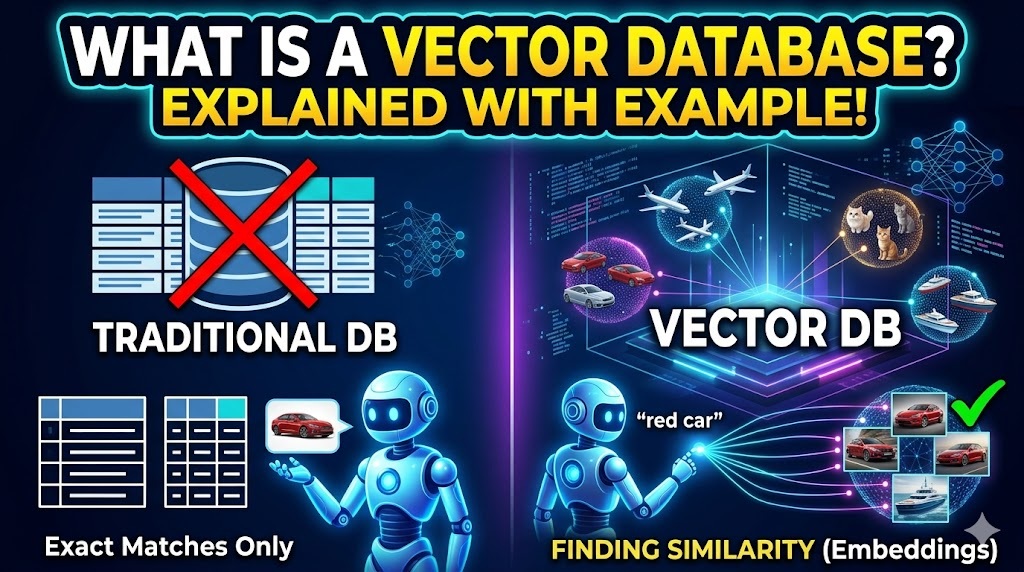
A Vector Database is a specialized type of database designed to store, index, and search information as vector embeddings.
- Traditional Databases 🗄️: (Relational or NoSQL) store data in neat rows, columns, or documents. They look for exact matches (e.g., “Find user ID 502”).
- Vector Databases 🚀: They are the engine behind modern AI. Instead of exact text, they operate on mathematical similarity, enabling systems to understand the meaning of data rather than just keywords.
✨ How It Works: The “Embedding” Magic
Computers don’t “understand” concepts like a sunset or a jazz melody—they only understand numbers. To bridge this gap, we use machine learning models to convert unstructured data (text, images, audio) into a list of numbers called a Vector.
- 🔢 Vector Embeddings: An array of numbers that represents the features of an object.Example: $[0.12, -0.59, 0.88, \dots]$
- 🗺️ Vector Space: These numbers act as coordinates in a high-dimensional space. Semantically similar items are placed close together, while unrelated items are placed far apart.
- 🔍 Querying: When you search, the database converts your query into a vector and finds the “nearest neighbors” in that mathematical space.
🎵 A Concrete Example: The “Vibe” Search
Imagine building a recommendation engine for a massive music streaming service.
- The Traditional Approach (Keyword Search) ⌨️If a user searches for “Upbeat summer songs,” a traditional database looks for those exact words. If a song is titled “Golden Hour” but tagged only as “Pop,” the database might miss it because the word “Upbeat” isn’t in the metadata.
- The Vector Database Approach 📈The system converts every song into a vector based on rhythm, tempo, lyrics, and mood:
- Song A (“Walking on Sunshine”): Represented as $\vec{v}_1 = [0.9, 0.8, 0.1]$
- Song B (“Golden Hour”): Represented as $\vec{v}_2 = [0.85, 0.75, 0.15]$
- Song C (“Sad Piano Ballad”): Represented as $\vec{v}_3 = [-0.9, -0.8, 0.9]$
Because $\vec{v}_1$ and $\vec{v}_2$ are numerically close, the database “knows” that if you like Song A, you’ll probably like Song B—even without shared keywords.
💡 Why Use Them?
- 📖 Semantic Search: Understanding intent (e.g., searching for “domesticated feline” and getting “house cat”).
- 🖼️ Similarity Search: Finding images that “look like” a reference photo.
- 🧠 Long-Term Memory for LLMs: This is the core of Retrieval-Augmented Generation (RAG). It allows AI like ChatGPT to look up facts from private documents for context-aware answers.
🛠️ Popular Vector Databases
If you are looking to implement one, these are the industry leaders:
| Database | Description |
| Pinecone 🌲 | A fully managed, cloud-native vector database. |
| Milvus ⚡ | An open-source option built for high scalability. |
| Weaviate 🕸️ | An open-source engine storing both objects and vectors. |
| Chroma 🌈 | An AI-native open-source embedding database. |
🧠 Vector Databases: అర్థం మరియు పనితీరు
ఒక Vector Database అనేది ఒక specialized database 🗄️. ఇది information ని కేవలం text గా కాకుండా vector embeddings రూపంలో store చేయడానికి, index చేయడానికి మరియు search చేయడానికి design చేయబడింది.
- Traditional Databases 📋: (Relational లేదా NoSQL) data ని rows మరియు columns లో store చేస్తాయి. ఇవి కేవలం Exact Matches కోసం చూస్తాయి (e.g., “Find user ID 502”).
- Vector Databases 🚀: ఇవి modern AI కి ఒక engine లాంటివి. ఇవి mathematical similarity మీద పని చేస్తూ, data యొక్క అసలు meaning ని అర్థం చేసుకుంటాయి.
✨ How It Works: The “Embedding” Magic
Computers కి sunset 🌅 లేదా ఒక melody 🎷 గురించి direct గా అర్థం కాదు; వాటికి తెలిసింది కేవలం numbers మాత్రమే. ఈ gap ని bridge చేయడానికి మనం machine learning models వాడి unstructured data ని ఒక list of numbers గా మారుస్తాం. దీనినే Vector అంటాము.
- 🔢 Vector Embeddings: ఇవి ఒక array of numbers. ఒక object యొక్క features ని ఇవి mathematical గా రిప్రెసెంట్ చేస్తాయి.ఉదాహరణకు: $[0.12, -0.59, 0.88, \dots]$
- 🌌 Vector Space: ఈ numbers ఒక high-dimensional space లో coordinates లాగా పనిచేస్తాయి. ఈ space లో, ఒకే రకమైన meaning (semantically similar) ఉన్న విషయాలు దగ్గరగా (close) ఉంటాయి, సంబంధం లేనివి దూరంగా ఉంటాయి.
- 🔍 Querying: మీరు search చేసినప్పుడు, అది “word match” కోసం చూడదు. మీ query ని ఒక vector గా మార్చి, ఆ space లో దానికి అత్యంత దగ్గరగా ఉన్న “nearest neighbors” ని వెతుకుతుంది.
🎵 A Concrete Example: The “Vibe” Search
మీరు ఒక పెద్ద music streaming service 🎧 కోసం recommendation engine బిల్డ్ చేస్తున్నారని ఊహించుకోండి.
- Traditional Approach (Keyword Search) ⌨️ఒకవేళ user “Upbeat summer songs” అని search చేస్తే, traditional database ఆ exact words కోసం చూస్తుంది. ఒకవేళ పాట పేరు “Golden Hour” అని ఉండి, tag “Pop” అని ఉంటే, “Upbeat” అనే word లేనందున database ఆ పాటను miss చేసే అవకాశం ఉంది.
- Vector Database Approach 📈ఈ system ప్రతి పాటను దాని rhythm, tempo, lyrics మరియు mood ని బట్టి ఒక vector గా మారుస్తుంది:
- Song A (“Walking on Sunshine”): $\vec{v}_1 = [0.9, 0.8, 0.1]$
- Song B (“Golden Hour”): $\vec{v}_2 = [0.85, 0.75, 0.15]$
- Song C (“Sad Piano Ballad”): $\vec{v}_3 = [-0.9, -0.8, 0.9]$
ఇక్కడ $\vec{v}_1$ మరియు $\vec{v}_2$ numbers పరంగా vector space లో చాలా దగ్గరగా ఉన్నాయి. కాబట్టి, keywords మ్యాచ్ కాకపోయినా Song A నచ్చిన వారికి Song B కూడా నచ్చుతుందని database కి అర్థమవుతుంది.
💡 Why Use Them? (ఎందుకు వాడాలి?)
- 📖 Semantic Search: Search వెనుక ఉన్న ఉద్దేశాన్ని అర్థం చేసుకోవడం (e.g., “domesticated feline” అని వెతికితే “house cat” రిజల్ట్స్ రావడం).
- 🖼️ Similarity Search: ఒక ఫోటో లాగా ఉండే మరిన్ని images ని వెతకడం.
- 🧠 Long-Term Memory for LLMs: ఇది Retrieval-Augmented Generation (RAG) కి ప్రాణం. దీనివల్ల ChatGPT వంటి AI మోడల్స్, ఒక పెద్ద library నుండి సరైన facts ని వెతికి context-aware answers ఇస్తాయి.
🛠️ Popular Vector Databases
ప్రస్తుతం మార్కెట్ లో ఉన్న కొన్ని ముఖ్యమైన లీడర్స్:
| Database | Description |
| Pinecone 🌲 | పూర్తిగా managed, cloud-native vector database. |
| Milvus ⚡ | Scalability కోసం డిజైన్ చేసిన open-source option. |
| Weaviate 🕸️ | Objects మరియు vectors రెండింటినీ store చేసే search engine. |
| Chroma 🌈 | AI-native open-source embedding database. |