🚀 *Gen AI Engineer Telugu (Production Focused)*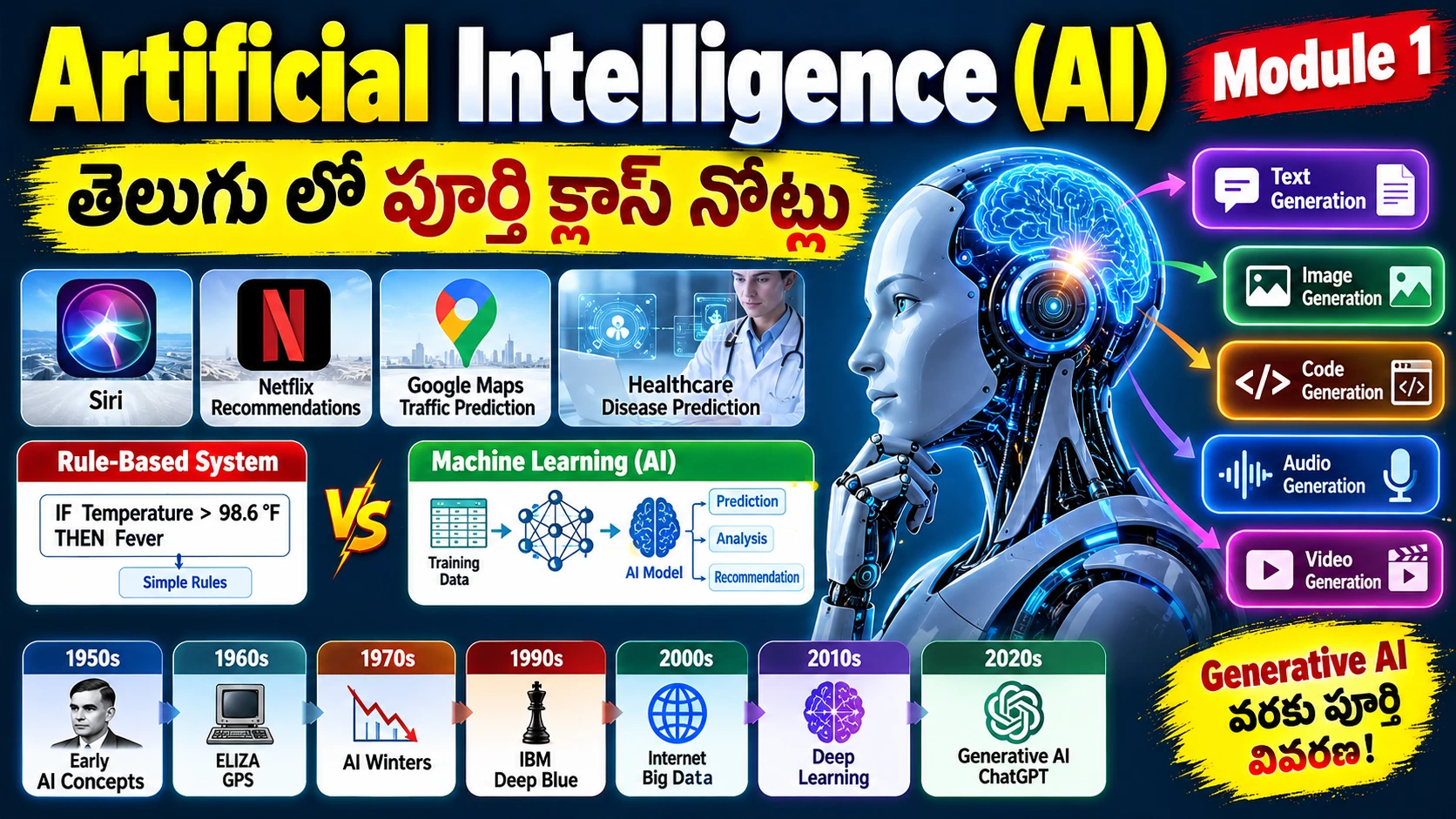
Module 1: Introduction to Artificial Intelligence (AI)
Introduction
Welcome to Module 1 of this course.
In this module, we will cover the foundational concepts that are important for understanding Artificial Intelligence (AI) and, later, more advanced concepts in Generative AI.
Before learning Generative AI, it is important to understand:
- What is Artificial Intelligence?
- How is AI different from traditional rule-based systems?
- How does AI learn from data?
- What is an AI model?
- Where do we use AI in our daily lives?
- How has Artificial Intelligence evolved over the years?
Let us start with the fundamentals.
1. What is Artificial Intelligence?
There are many definitions of Artificial Intelligence (AI), but most of them point to the same basic idea.
Simple Definition
Artificial Intelligence is the technology of making machines or computer programs smarter by giving them the ability to perform tasks that normally require human intelligence.
Human beings have many capabilities.
For example, humans can:
- See
- Hear
- Touch
- Smell
- Learn
- Think
- Understand
- Analyze
- Make decisions
- Solve problems
The basic idea behind AI is:
What if we give some of these human-like capabilities to machines or computer programs?
That is the fundamental concept behind Artificial Intelligence.
AI enables machines to process information, identify patterns, learn from data, make predictions, understand language, recognize images, and make decisions.
2. Human Intelligence vs Artificial Intelligence
Human intelligence comes naturally to human beings.
For example, when a person sees a vehicle, the human brain can identify:
- What type of vehicle it is
- Whether it is moving
- How fast it may be moving
- Whether it is dangerous
- What action should be taken
AI attempts to perform similar types of intelligent tasks using computers and algorithms.
For example, an AI-powered computer vision system can analyze an image and identify whether the image contains:
- A person
- A car
- A dog
- A building
- A road
- Other objects
Therefore, AI can be viewed as an attempt to enable machines to perform tasks associated with human intelligence.
3. Traditional Rule-Based Systems
Before modern AI became widely popular, many systems were developed using rule-based systems.
A rule-based system works by explicitly defining rules and conditions.
The programmer tells the computer:
If this condition happens, perform this action.
Example: Fever Detection
Suppose we want to determine whether a patient has a fever.
We could create a simple rule:
IF temperature > 98.6°F
THEN display “Fever”
For example:
| Patient Temperature | Rule Result |
|---|---|
| 98°F | No Fever |
| 98.6°F | Depends on the exact rule |
| 100°F | Fever |
| 102°F | Fever |
The machine simply follows the rule that was programmed.
Problem with Rule-Based Systems
This approach works when the problem is simple.
However, real-world problems are usually much more complicated.
Not every disease can be identified only by checking body temperature.
A doctor may need to consider many additional factors such as:
- Body pain
- Fatigue
- Vomiting
- Cough
- Headache
- Duration of fever
- Age
- Previous medical history
- Other symptoms
- Previous treatments
- Test results
Therefore, a simple rule such as:
“Temperature > 98.6°F = Fever”
may not be sufficient to accurately determine a disease or recommend treatment.
4. AI and Learning from Data
Instead of manually writing thousands of rules, AI systems can learn patterns from large amounts of data.
Let us continue with the medical example.
Suppose a hospital has collected information about millions of patients treated in the past.
The data may contain columns such as:
- Patient Age
- Body Temperature
- Body Pain
- Fatigue
- Vomiting
- Cough
- Headache
- Number of Days with Fever
- Test Results
- Disease
- Treatment
- Medication
- Recovery Information
This historical information is called data, and the information used to teach an AI system is generally referred to as training data.
5. What is Training Data?
Training Data
Training data is historical data used to train an AI or Machine Learning system so that it can learn patterns and relationships.
For example:
| Age | Temperature | Body Pain | Fatigue | Vomiting | Disease |
|---|---|---|---|---|---|
| 25 | 101°F | Yes | Yes | No | Disease A |
| 45 | 102°F | Yes | Yes | Yes | Disease B |
| 7 | 100°F | Yes | No | No | Disease C |
| 68 | 103°F | Yes | Yes | Yes | Disease B |
When a large amount of such historical information is available, a Machine Learning algorithm can analyze the data and identify patterns.
For example, it may discover that:
- Certain symptoms frequently occur together.
- Different age groups may have different risk patterns.
- A combination of symptoms can be associated with a particular disease.
- Different patient characteristics may lead to different treatment outcomes.
The machine does not simply memorize a single rule. It learns patterns from the available training data.
6. From Data to an AI Model
The next important concept is the AI model.
The general process can be understood as:
Historical Data → Training → Learned Patterns → Model
In other words, the machine takes historical data and uses an algorithm to learn patterns from that data.
The result is a trained model.
A model is a computational representation of the patterns learned from training data.
7. What Happens When a New Patient Arrives?
Now imagine a new patient arrives at the hospital.
We enter the relevant information into the trained model:
- Age
- Temperature
- Symptoms
- Test results
- Other relevant information
The model analyzes the new input based on patterns it learned during training.
It can then generate an output such as:
- A predicted disease
- A risk score
- A probability
- A classification
- A recommendation
For example:
New Patient Data → AI Model → Prediction/Analysis
This is one of the fundamental ways AI and Machine Learning systems are used.
Important Point
The model does not magically know the answer.
Its output depends on:
- Quality of training data
- Quantity of training data
- Relevance of the data
- Quality of the algorithm
- Quality of the model
- Quality of the new input
Therefore, AI systems are not automatically correct simply because they use large amounts of data.
In real healthcare applications, AI systems should support qualified medical professionals rather than replace professional medical judgment.
8. Rule-Based System vs AI-Based System
The key difference can be understood as follows.
| Rule-Based System | AI / Machine Learning System |
|---|---|
| Rules are explicitly written by programmers | Patterns can be learned from data |
| Depends heavily on predefined conditions | Depends on learned patterns |
| Difficult to handle highly complex situations with many interacting factors | Can model complex relationships when trained appropriately |
| Updating often requires modifying rules | Updating may involve retraining or fine-tuning |
| Usually suitable for deterministic logic | Suitable for prediction, classification, pattern recognition and other data-driven tasks |
Simple Example
Rule-Based Approach
IF temperature > 98.6°F
THEN Fever
ELSE No Fever
AI-Based Approach
Patient Data
     ↓
AI / ML Model
     ↓
Learned Patterns
     ↓
Prediction / Analysis
The AI approach can consider many factors together instead of depending on only one manually written rule.
9. Why AI is Powerful
Real-world problems often contain many variables.
For example, a medical prediction problem may include:
- Age
- Temperature
- Symptoms
- Medical history
- Test results
- Previous treatments
- Other patient characteristics
Trying to manually write a rule for every possible combination can become extremely complicated.
If there are millions of historical records available, Machine Learning can be used to discover useful patterns within the data.
Therefore, one of the major strengths of AI is its ability to work with large amounts of information and learn complex patterns.
10. Real-Life Applications of Artificial Intelligence
AI is not limited to hospitals or medical applications.
We already use AI in many areas of our daily lives.
In many cases, people use AI without even realizing it.
10.1 Siri and Voice Assistants
Apple’s Siri is an example of AI-powered technology.
A voice assistant can process spoken language and perform tasks such as:
- Answering questions
- Setting reminders
- Sending messages
- Making calls
- Searching for information
- Controlling supported devices
Technologies such as Speech Recognition, Natural Language Processing (NLP) and Machine Learning are involved in modern voice-assistant systems.
10.2 Netflix Recommendations
Netflix uses recommendation technology to suggest movies and shows.
For example, suppose you frequently watch:
- Action movies
- Science-fiction movies
- Thriller movies
A recommendation system can use your viewing behavior and other signals to suggest content that may be relevant to your interests.
Therefore:
Past Preferences + Viewing Behavior → Recommendation System → Suggested Content
This is an example of AI being used for personalization and recommendation.
10.3 Google Maps and Traffic Prediction
Google Maps provides another familiar example.
It can estimate traffic conditions and travel times for routes.
It can also suggest alternative routes when appropriate.
For example:
Current Location → Destination → Traffic/Route Information → Estimated Travel Time → Route Recommendation
AI and Machine Learning can be used as part of systems that analyze traffic patterns, historical information and other signals to improve routing and prediction.
11. AI is Used Across Industries
AI is not limited to a single industry.
It is used across many sectors, including:
Healthcare
- Medical image analysis
- Disease prediction
- Clinical decision support
- Drug discovery
Banking and Finance
- Fraud detection
- Risk analysis
- Credit assessment
- Customer support
Retail
- Product recommendations
- Demand forecasting
- Customer personalization
Manufacturing
- Predictive maintenance
- Quality inspection
- Robotics
Transportation
- Route optimization
- Traffic prediction
- Autonomous driving technologies
Education
- Personalized learning
- Automated assessment
- AI tutors
Entertainment
- Content recommendations
- Content generation
- Personalization
Cybersecurity
- Threat detection
- Anomaly detection
- Security monitoring
Therefore, Artificial Intelligence is a technology that cuts across industries.
12. Artificial Intelligence Evolution
Now let us understand how Artificial Intelligence has evolved over the years.
AI did not appear suddenly.
It has developed over several decades.
A simplified historical journey is shown below:
1950s → Early AI Concepts
1960s → Early AI Programs
1970s → AI Slowdown / Limited Progress
1990s → Major Milestones
2000s → Internet + Big Data
2010s → Deep Learning
2020s → Generative AI
Let us examine each stage.
13. AI in the 1950s
The term Artificial Intelligence is strongly associated with John McCarthy, who used the term in the 1950s.
The early foundations of AI were also influenced by thinkers and researchers such as Alan Turing.
Alan Turing
Alan Turing was one of the important pioneers whose work contributed significantly to the foundations of computer science and the study of machine intelligence.
In 1950, Turing published his famous paper:
“Computing Machinery and Intelligence”
He proposed the question:
Can machines think?
This work became highly influential in discussions about machine intelligence.
14. The Birth of the Term Artificial Intelligence
In 1956, the Dartmouth workshop became an important milestone in the history of AI.
The term Artificial Intelligence was proposed in connection with this research initiative led by John McCarthy and other researchers.
This period is commonly regarded as a major starting point for AI as a formal academic field.
15. AI in the 1960s
During the 1960s, researchers developed several early AI programs.
Two historically important examples are:
ELIZA
ELIZA was an early natural-language processing program developed by Joseph Weizenbaum at MIT in the 1960s.
It simulated conversation by using pattern-matching techniques.
ELIZA is an important historical example of early attempts to make computers interact with humans using language.
General Problem Solver (GPS)
General Problem Solver (GPS) was an early AI program developed by Allen Newell, Herbert A. Simon, and Cliff Shaw.
It was designed to solve certain general classes of problems using symbolic reasoning.
These early systems were very different from today’s Deep Learning and Generative AI systems, but they played an important role in AI research history.
16. AI in the 1970s
The 1970s did not produce the level of progress that many researchers had hoped for.
AI research faced several challenges, including:
- Limited computing power
- Limited availability of large datasets
- Difficulties in solving real-world problems
- High expectations compared with actual capabilities
This period contributed to what later became known as AI winters, periods when enthusiasm and investment in AI declined.
17. AI in the 1990s – IBM Deep Blue
One of the most famous AI milestones came in the 1990s.
IBM developed Deep Blue, a chess-playing computer system.
In 1997, Deep Blue defeated world chess champion Garry Kasparov in a match.
This became a landmark event because it demonstrated that computers could perform extremely sophisticated tasks in a highly complex domain.
Important Note
Deep Blue is historically important, but it was not a modern Deep Learning system in the way we use the term today.
It relied heavily on:
- Search
- Game-tree analysis
- Evaluation functions
- Specialized chess knowledge
- Powerful computing
Nevertheless, its success became an important milestone in the history of AI.
18. AI in the 2000s – Internet and Big Data
During the 2000s, AI started becoming increasingly practical.
Two major factors contributed to this development:
1. Internet Growth
The rapid growth of the internet generated massive amounts of digital information.
Examples include:
- Web pages
- Images
- Videos
- Text
- Search queries
- User interactions
2. Big Data
Organizations began collecting and storing enormous amounts of data.
More data made it possible for Machine Learning systems to learn more effectively in many applications.
At the same time, improvements in computing hardware and software made it more practical to process large datasets.
19. AI in the 2010s – Deep Learning
The 2010s were an extremely important period for Artificial Intelligence.
This was the era in which Deep Learning became highly successful.
Deep Learning is a subset of Machine Learning that uses multi-layer neural networks.
It achieved major advances in areas such as:
- Image recognition
- Speech recognition
- Natural Language Processing
- Computer vision
- Translation
- Recommendation systems
For example, Deep Learning systems became much better at recognizing:
- Faces
- Objects
- Spoken words
- Text
- Complex patterns
Simple Hierarchy
A useful way to understand the relationship is:
Artificial Intelligence
↓
Machine Learning
↓
Deep Learning
Deep Learning is therefore a subset of Machine Learning, and Machine Learning is a broader area within Artificial Intelligence.
20. AI in the 2020s – Generative AI
The 2020s brought a major transformation in Artificial Intelligence through Generative AI.
Generative AI systems can create new content based on learned patterns.
They can generate:
- Text
- Images
- Audio
- Video
- Code
One of the most important developments was the rise of large language models and generative AI applications.
Examples include systems capable of:
- Answering questions
- Writing articles
- Summarizing text
- Generating code
- Translating languages
- Creating images
- Assisting with research
- Supporting software development
21. Important Timeline Correction: GPT-3 and ChatGPT
The source material mentions OpenAI GPT-3 in 2022, but there is an important historical distinction.
GPT-3
GPT-3 was introduced in 2020.
It was a major milestone in large language models and demonstrated the ability of a language model to generate coherent human-like text.
ChatGPT
ChatGPT was publicly introduced by OpenAI in November 2022.
Its release significantly accelerated public awareness and adoption of Generative AI.
Therefore, a more accurate timeline is:
2020 → GPT-3
2022 → ChatGPT and rapid Generative AI adoption
This distinction is important when teaching students the history of Generative AI.
22. What is Generative AI?
Now that we understand the evolution of AI, we can introduce Generative AI.
Traditional AI systems often focus on tasks such as:
- Classification
- Prediction
- Detection
- Recommendation
- Decision support
Generative AI goes one step further by generating new content.
Definition
Generative AI is a class of Artificial Intelligence systems capable of generating new content based on patterns learned from training data.
Examples include:
Text Generation
A Generative AI model can create:
- Articles
- Emails
- Summaries
- Stories
- Documentation
- Questions and answers
Image Generation
AI can create images from text prompts.
Code Generation
AI can generate:
- Python code
- Java code
- JavaScript
- SQL
- HTML/CSS
- Infrastructure code
Audio Generation
AI can generate or transform speech and audio.
Video Generation
Modern Generative AI systems can generate or transform video content.
23. Why Generative AI is Different
Traditional Machine Learning might answer:
“Which category does this input belong to?”
For example:
Email → Spam or Not Spam
A recommendation system might answer:
“Which movie is this user likely to watch?”
Generative AI can instead perform tasks such as:
“Write an email explaining this problem.”
or:
“Create Python code to read a CSV file.”
or:
“Generate an image of a futuristic city.”
This ability to create new content is one of the defining characteristics of Generative AI.
24. Simple Understanding of the AI Journey
The evolution can be simplified like this:
Stage 1 – Rule-Based Systems
Humans define explicit rules.
IF condition
THEN action
Stage 2 – Machine Learning
Machines learn patterns from historical data.
Data → Learning Algorithm → ModelStage 3 – Deep Learning
Neural networks with multiple layers learn complex representations from large datasets.
Large Data → Deep Neural Network → Learned RepresentationStage 4 – Generative AI
Models can generate new content based on learned patterns.
Prompt/Input → Generative AI Model → New ContentThis progression provides a useful foundation for understanding modern AI systems.
25. Key Concepts to Remember
Artificial Intelligence
AI refers broadly to the field of creating systems that can perform tasks associated with human intelligence.
Rule-Based System
A system that uses explicitly defined rules and conditions.
Machine Learning
A field in which algorithms learn patterns from data to make predictions or decisions.
Training Data
Historical data used to train a Machine Learning model.
AI Model
A computational system that represents patterns learned during training and can be used to process new inputs.
Deep Learning
A Machine Learning approach based on neural networks with multiple layers.
Generative AI
AI systems capable of generating new content such as text, images, audio, video, or code.
26. Real-World AI Examples – Quick Revision
| Application | Example | AI Use |
|---|---|---|
| Voice Assistant | Siri | Speech and language processing |
| Entertainment | Netflix | Recommendations |
| Navigation | Google Maps | Traffic and route prediction |
| Healthcare | Medical AI | Prediction and analysis |
| Banking | Fraud Detection | Anomaly/pattern detection |
| Retail | Product Recommendations | Personalization |
| Manufacturing | Predictive Maintenance | Failure prediction |
| Generative AI | ChatGPT | Text generation |
| Image Generation | AI Image Models | Image creation |
| Coding Assistants | AI coding tools | Code generation |
27. Rule-Based System vs Machine Learning vs Generative AI
| Technology | Main Idea | Example |
|---|---|---|
| Rule-Based System | Follow manually written rules | IF temperature > threshold → alert |
| Machine Learning | Learn patterns from data | Predict disease risk |
| Deep Learning | Learn complex representations using neural networks | Image recognition |
| Generative AI | Generate new content | Write an article or generate code |
28. Complete AI Evolution Timeline
| Period | Major Development |
|---|---|
| 1950s | Early foundations of AI and the emergence of the AI field |
| 1956 | Dartmouth workshop and formal development of AI as a research field |
| 1960s | Early AI programs such as ELIZA and General Problem Solver |
| 1970s | Limited progress and periods of reduced AI enthusiasm |
| 1990s | IBM Deep Blue becomes a major AI milestone |
| 2000s | Internet, Big Data and increased computing enable wider AI adoption |
| 2010s | Deep Learning achieves major breakthroughs in vision and speech |
| 2020 | OpenAI GPT-3 becomes a major language-model milestone |
| 2022 | ChatGPT popularizes Generative AI for the general public |
| 2020s | Rapid growth of Generative AI across text, image, audio, video and code |
29. Why This Foundation is Important for Generative AI
Before learning advanced Generative AI topics, it is important to understand the broader AI ecosystem.
Generative AI did not develop independently.
It evolved from decades of work in areas such as:
- Artificial Intelligence
- Machine Learning
- Neural Networks
- Deep Learning
- Natural Language Processing
- Computer Vision
- Large-scale computing
- Big Data
Understanding this evolution makes advanced Generative AI concepts easier to understand.
For example, later in the course you may encounter concepts such as:
- Large Language Models (LLMs)
- Transformers
- Embeddings
- Prompt Engineering
- Retrieval-Augmented Generation (RAG)
- Fine-Tuning
- AI Agents
- Multimodal AI
- Agentic AI
These concepts are easier to understand when the basic foundation of AI is clear.
30. Module 1 Summary
In this module, we learned that Artificial Intelligence is about making machines capable of performing tasks that require human-like intelligence.
We compared AI with traditional rule-based systems.
A rule-based system depends on explicitly written rules, while Machine Learning systems can learn patterns from historical data.
We also learned how historical data can be used as training data, from which a model can learn patterns and then process new inputs.
We explored everyday examples of AI such as:
- Siri
- Netflix recommendations
- Google Maps
We also discussed how AI is used across many industries.
Finally, we reviewed the evolution of Artificial Intelligence:
Early AI → Rule-Based Systems → Machine Learning → Deep Learning → Generative AI
The 2020s have brought a major transformation through Generative AI, with systems that can generate text, images, code, audio and video.
31. Important Interview Questions
1. What is Artificial Intelligence?
Artificial Intelligence is the field of creating machines and software systems capable of performing tasks that normally require human intelligence.
2. What is a rule-based system?
A rule-based system uses predefined rules and conditions to determine outputs or actions.
3. How is AI different from rule-based systems?
Rule-based systems depend on explicitly programmed rules, while many AI and Machine Learning systems can learn patterns from data.
4. What is training data?
Training data is historical information used to train a Machine Learning model.
5. What is an AI model?
An AI model is a computational representation of patterns learned from data that can be used to process new inputs.
6. Give some examples of AI in daily life.
Examples include Siri, Netflix recommendations, Google Maps traffic prediction, spam detection and recommendation systems.
7. Who coined the term Artificial Intelligence?
The term Artificial Intelligence is associated with John McCarthy, particularly through the Dartmouth AI research proposal in the 1950s.
8. Who is Alan Turing?
Alan Turing was a pioneering computer scientist and mathematician whose work greatly influenced the foundations of computing and the study of machine intelligence.
9. What is Deep Learning?
Deep Learning is a subset of Machine Learning that uses multi-layer neural networks to learn complex patterns.
10. What is Generative AI?
Generative AI refers to AI systems that can generate new content such as text, images, audio, video and code.
32. Key Takeaways
AI = Making machines perform intelligent tasks
Rule-Based System = Humans define the rules
Machine Learning = Machines learn patterns from data
Deep Learning = Neural networks learn complex patterns
Generative AI = AI generates new content
Simple Flow
Human Intelligence
        ↓
Artificial Intelligence
        ↓
Machine Learning
        ↓
Deep Learning
        ↓
Generative AI
        ↓
Text | Image | Audio | Video | Code
Module 1: Artificial Intelligence (AI) – Complete Class Notes
Introduction
ఈ course లోని Module 1 కి స్వాగతం.
ఈ moduleలో మనం Artificial Intelligence (AI) కి సంబంధించిన foundational concepts నేర్చుకుంటాం. ఇవి తరువాత వచ్చే Generative AI మరియు advanced conceptsను అర్థం చేసుకోవడానికి చాలా ఉపయోగపడతాయి.
ఈ moduleలో ముఖ్యంగా క్రింది topics గురించి తెలుసుకుంటాం:
- Artificial Intelligence అంటే ఏమిటి?
- Rule-Based Systems అంటే ఏమిటి?
- AI మరియు Rule-Based Systems మధ్య difference ఏమిటి?
- Machine Learning data నుంచి ఎలా నేర్చుకుంటుంది?
- Training Data అంటే ఏమిటి?
- AI Model అంటే ఏమిటి?
- మన daily lifeలో AI ఎక్కడ ఉపయోగిస్తున్నాం?
- Artificial Intelligence ఎలా evolve అయింది?
- Machine Learning, Deep Learning మరియు Generative AI మధ్య సంబంధం ఏమిటి?
ముందుగా basics నుంచి ప్రారంభిద్దాం.
1. What is Artificial Intelligence?
Artificial Intelligence (AI) గురించి చాలా definitions ఉన్నాయి. అయితే వాటి basic idea దాదాపు ఒకటే.
Simple Definition
Artificial Intelligence అంటే machines లేదా computer programsకి human intelligenceకి సంబంధించిన కొన్ని capabilities ఇవ్వడం.
మనుషులకు ఎన్నో abilities ఉన్నాయి.
ఉదాహరణకు humans:
- See చేయగలరు
- Hear చేయగలరు
- Touch చేయగలరు
- Smell చేయగలరు
- Learn చేయగలరు
- Think చేయగలరు
- Understand చేయగలరు
- Analyze చేయగలరు
- Decisions తీసుకోగలరు
- Problems solve చేయగలరు
ఇప్పుడు ఒక machine లేదా computer programకి కూడా ఇలాంటి intelligent capabilitiesలో కొన్ని ఇవ్వగలిగితే?
అదే basic idea of Artificial Intelligence.
సులభంగా చెప్పాలంటే:
AI అనేది machinesను smartగా తయారు చేసి, human intelligence అవసరమయ్యే కొన్ని tasks చేయించే technology.
AI systems dataని process చేయగలవు, patternsని identify చేయగలవు, predictions చేయగలవు, languageని understand చేయగలవు, imagesని recognize చేయగలవు మరియు decisionsకి support ఇవ్వగలవు.
2. Human Intelligence vs Artificial Intelligence
Human Intelligence మనుషుల్లో సహజంగా ఉంటుంది.
ఉదాహరణకు ఒక మనిషి ఒక vehicleని చూసినప్పుడు:
- అది ఏ vehicle typeో identify చేయగలడు
- అది movingలో ఉందో లేదో తెలుసుకోగలడు
- దాని speedని అంచనా వేయగలడు
- అది dangerousగా ఉందో లేదో గుర్తించగలడు
- తదుపరి ఏ action తీసుకోవాలో decide చేయగలడు
ఇలాంటి intelligent tasksలో కొన్నింటిని computer systems ద్వారా చేయించడానికి ప్రయత్నించేదే Artificial Intelligence.
ఉదాహరణకు Computer Vision system ఒక imageని analyze చేసి అందులో:
- Person
- Car
- Dog
- Building
- Road
వంటివి identify చేయగలదు.
అందువల్ల AIని broadly:
Human intelligenceకి సంబంధించిన tasksను machines ద్వారా perform చేయించే technology
గా అర్థం చేసుకోవచ్చు.
3. Traditional Rule-Based Systems
Modern AI widespread అవ్వడానికి ముందు చాలా systemsను Rule-Based Systems ద్వారా build చేసేవారు.
Rule-Based Systemలో programmer ముందుగానే rules మరియు conditions define చేస్తాడు.
సాధారణంగా logic ఇలా ఉంటుంది:
IF condition is true THEN perform an action
అంటే:
ఈ condition ఉంటే → ఈ action చేయాలి
4. Example: Fever Detection
ఒక patientకి fever ఉందా లేదా తెలుసుకోవాలని అనుకుందాం.
మనము ఒక simple rule రాయవచ్చు:
IF Temperature > 98.6°F
THEN Display "Fever"
ఇది ఒక predefined rule.
ఉదాహరణ:
| Patient Temperature | Result |
|---|---|
| 98°F | No Fever |
| 98.6°F | Rule పై ఆధారపడి ఉంటుంది |
| 100°F | Fever |
| 102°F | Fever |
ఉదాహరణకు temperature 98°F అయితే అది 98.6°F కంటే తక్కువ.
అందువల్ల:
Result = No Fever
అలాగే temperature 100°F అయితే:
Result = Fever
ఇక్కడ computer స్వయంగా ఏదీ నేర్చుకోవడం లేదు.
Programmer ఇచ్చిన ruleనే follow చేస్తోంది.
5. Problem with Rule-Based Systems
Simple problems కోసం Rule-Based Systems బాగా పనిచేస్తాయి.
కానీ real-world problems అంత simpleగా ఉండవు.
ప్రతి diseaseని కేవలం body temperature ఆధారంగా identify చేయలేం.
ఒక doctor మరిన్ని factorsను consider చేయవచ్చు.
ఉదాహరణకు:
- Body Pain
- Fatigue
- Vomiting
- Cough
- Headache
- Fever ఎన్ని రోజులుగా ఉంది
- Age
- Medical History
- Previous Treatment
- Test Results
- ఇతర Symptoms
ఇవన్నీ consider చేయాల్సి రావచ్చు.
అందువల్ల:
Temperature > 98.6°F = Fever
అనే ఒకే ruleతో patientకి ఏ disease ఉందో లేదా ఏ treatment ఇవ్వాలో accurately చెప్పడం సాధ్యం కాదు.
6. AI and Learning from Data
ఇక్కడ Artificial Intelligence లేదా Machine Learning ఉపయోగపడుతుంది.
ప్రతి ఒక్క situationకి thousands of rules manually రాయడం కంటే machineకి పెద్ద మొత్తంలో historical data ఇచ్చి patterns నేర్చుకునేలా చేయవచ్చు.
మన medical exampleనే తీసుకుందాం.
ఒక hospitalలో గతంలో treatment పొందిన millions of patients information ఉందని అనుకుందాం.
ఆ dataలో columns ఇలా ఉండవచ్చు:
- Patient Age
- Body Temperature
- Body Pain
- Fatigue
- Vomiting
- Cough
- Headache
- Number of Days with Fever
- Test Results
- Disease
- Treatment
- Medication
- Recovery Information
ఈ historical informationలో machineకి నేర్పడానికి ఉపయోగించే భాగాన్ని generally Training Data అంటారు.
7. What is Training Data?
Training Data Definition
Training Data అంటే Machine Learning లేదా AI Modelకి patterns మరియు relationships నేర్పడానికి ఉపయోగించే historical data.
ఉదాహరణకు:
| Age | Temperature | Body Pain | Fatigue | Vomiting | Disease |
|---|---|---|---|---|---|
| 25 | 101°F | Yes | Yes | No | Disease A |
| 45 | 102°F | Yes | Yes | Yes | Disease B |
| 7 | 100°F | Yes | No | No | Disease C |
| 68 | 103°F | Yes | Yes | Yes | Disease B |
ఇలాంటి వేల, లక్షల లేదా millions of records ఉన్నప్పుడు Machine Learning algorithm ఆ dataని analyze చేసి patternsని గుర్తించగలదు.
ఉదాహరణకు machine ఇలా patterns గుర్తించవచ్చు:
- కొన్ని symptoms తరచుగా కలిసి రావచ్చు
- Different age groupsకి different patterns ఉండవచ్చు
- కొన్ని symptoms combination ఒక diseaseతో సంబంధం కలిగి ఉండవచ్చు
- Different patient characteristics వల్ల treatment outcomes మారవచ్చు
అంటే machine కేవలం ఒక ruleని memorize చేయడం కాదు.
అది dataలో patterns నేర్చుకుంటుంది.
8. From Data to an AI Model
ఇప్పుడు మరో ముఖ్యమైన concept:
AI Model
ఒక basic process:
Historical Data
       ↓
Training
       ↓
Learned Patterns
       ↓
AI / ML Model
అంటే machine historical dataని తీసుకుని training process ద్వారా patterns నేర్చుకుంటుంది.
ఆ learning result ఆధారంగా ఒక trained model తయారవుతుంది.
AI Model అంటే?
AI Model అనేది training data నుంచి నేర్చుకున్న patternsని represent చేసే computational system.
ఈ modelకి తరువాత కొత్త data లేదా కొత్త input ఇచ్చినప్పుడు అది తనకు నేర్చుకున్న patterns ఆధారంగా output ఇవ్వగలదు.
9. What Happens When a New Patient Arrives?
ఇప్పుడు ఒక new patient hospitalకి వచ్చాడని అనుకుందాం.
ఈ patientకి సంబంధించిన informationను collect చేస్తాము:
- Age
- Temperature
- Symptoms
- Test Results
- ఇతర relevant information
ఈ dataని trained AI Modelకి inputగా ఇస్తాము.
Model training సమయంలో నేర్చుకున్న patterns ఆధారంగా కొత్త patient dataని analyze చేస్తుంది.
తర్వాత outputగా ఇవ్వగలిగేవి:
- Predicted Disease
- Risk Score
- Probability
- Classification
- Recommendation
Simple flow:
New Patient Data
       ↓
AI Model
       ↓
Analysis / Prediction
Important Point
AI Model ఇచ్చే output ఎప్పుడూ 100% correct అని అనుకోవద్దు.
Output quality అనేక factorsపై depend అవుతుంది:
- Training Data quality
- Amount of Training Data
- Data relevance
- Algorithm quality
- Model quality
- New Input quality
కాబట్టి AI systemని especially healthcare వంటి high-stakes areasలో qualified professionalsకు support చేసే toolగా చూడాలి.
10. Rule-Based System vs AI-Based System
ఇప్పుడు రెండు approachesను compare చేద్దాం.
| Rule-Based System | AI / Machine Learning System |
|---|---|
| Rules manually define చేస్తారు | Data నుంచి patterns నేర్చుకుంటుంది |
| Programmer predefined conditions ఇస్తాడు | Model historical data నుంచి learning చేస్తుంది |
| Complex combinations handle చేయడం కష్టం కావచ్చు | Complex patternsని model చేయగలదు |
| Rules change చేయడానికి programming అవసరం కావచ్చు | Modelని retrain చేయాల్సి రావచ్చు |
| Simple deterministic logicకి useful | Prediction, classification, pattern recognition వంటి tasksకి useful |
Rule-Based Example
IF Temperature > 98.6°F
THEN Fever
ELSE No Fever
AI-Based Example
Historical Data
      ↓
Machine Learning
      ↓
Training
      ↓
Model
      ↓
New Input
      ↓
Prediction / Analysis
11. Why AI is Powerful
Real-world problemsలో చాలా variables ఉండవచ్చు.
ఒక medical prediction problemలో:
- Age
- Temperature
- Symptoms
- Medical History
- Test Results
- Previous Treatment
- Other patient characteristics
వంటి factors ఉండవచ్చు.
ప్రతి possible combinationకి manually rules రాయడం చాలా difficult.
Dataలో millions of records ఉంటే Machine Learning ఆ dataలో useful patternsని identify చేయడానికి ఉపయోగపడుతుంది.
అందుకే AI యొక్క ఒక major strength:
Large amounts of dataలో patternsని identify చేసి predictions లేదా decisionsకి support ఇవ్వగలగడం.
12. Real-Life Applications of AI
AI మన daily lifeలో చాలా చోట్ల ఉపయోగించబడుతోంది.
చాలాసార్లు మనం AIని ఉపయోగిస్తున్నామనే విషయం కూడా మనకు తెలియకపోవచ్చు.
12.1 Siri and Voice Assistants
Apple devicesలో ఉండే Siri ఒక well-known AI-powered technology.
Voice Assistant ద్వారా:
- Questions అడగవచ్చు
- Reminders set చేయవచ్చు
- Messages send చేయవచ్చు
- Calls చేయవచ్చు
- Information search చేయవచ్చు
- Supported devices control చేయవచ్చు
ఇలాంటి systemsలో:
- Speech Recognition
- Natural Language Processing (NLP)
- Machine Learning
వంటి technologies ఉపయోగించబడతాయి.
12.2 Netflix Recommendations
Netflixలో మనం movie లేదా TV show watch చేసినప్పుడు, తరువాత మనకు కొత్త content recommendations కనిపిస్తాయి.
ఉదాహరణకు మీరు ఎక్కువగా:
- Action Movies
- Science Fiction
- Thriller Movies
చూస్తే, recommendation system మీ previous behavior మరియు preferences ఆధారంగా similar content suggest చేయవచ్చు.
Simple flow:
Past Preferences
       +
Viewing History
       ↓
Recommendation System
       ↓
Suggested Content
ఇది AI-based personalization and recommendationకి ఒక example.
12.3 Google Maps and Traffic Prediction
Google Maps కూడా intelligent technologiesకి ఒక మంచి example.
Google Maps:
- Traffic conditions estimate చేయగలదు
- Travel time predict చేయగలదు
- Routes compare చేయగలదు
- Alternative routes suggest చేయగలదు
ఉదాహరణ:
Current Location
       +
Destination
       +
Traffic Information
       ↓
Route / Time Prediction
       ↓
Recommended Route
Traffic patterns, historical information మరియు ఇతర signalsని analyze చేయడం ద్వారా routing మరియు prediction systems improve చేయవచ్చు.
13. AI Across Different Industries
AI ఒక్క industryకి మాత్రమే పరిమితం కాదు.
చాలా industriesలో AI ఉపయోగించబడుతోంది.
Healthcare
AI applications:
- Medical Image Analysis
- Disease Prediction
- Clinical Decision Support
- Drug Discovery
Banking and Finance
AI applications:
- Fraud Detection
- Risk Analysis
- Credit Assessment
- Customer Support
Retail
AI applications:
- Product Recommendations
- Demand Forecasting
- Customer Personalization
Manufacturing
AI applications:
- Predictive Maintenance
- Quality Inspection
- Robotics
Transportation
AI applications:
- Route Optimization
- Traffic Prediction
- Autonomous Driving Technologies
Education
AI applications:
- Personalized Learning
- Automated Assessment
- AI Tutors
Entertainment
AI applications:
- Content Recommendations
- Content Generation
- Personalization
Cybersecurity
AI applications:
- Threat Detection
- Anomaly Detection
- Security Monitoring
అందువల్ల:
AI అనేది cross-industry technology.
14. Evolution of Artificial Intelligence
Artificial Intelligence ఒక్కసారిగా develop కాలేదు.
ఇది అనేక దశాబ్దాల research మరియు technological improvements ఫలితంగా evolve అయింది.
ఒక simple timeline:
1950s → Early AI Concepts
1960s → Early AI Programs
1970s → Limited Progress
1990s → Major AI Milestones
2000s → Internet + Big Data
2010s → Deep Learning
2020s → Generative AI
ఇప్పుడు ఒక్కో stageని చూద్దాం.
15. AI in the 1950s
Artificial Intelligence అనే termను 1950sలో John McCarthyతో అనుసంధానిస్తారు.
అదే సమయంలో Alan Turing వంటి researchers machine intelligenceకి సంబంధించిన foundational ideasపై ముఖ్యమైన work చేశారు.
Alan Turing
Alan Turing ఒక ప్రముఖ mathematician మరియు computer science pioneer.
1950లో ఆయన:
“Computing Machinery and Intelligence”
అనే famous paper ప్రచురించారు.
అందులో ఒక ప్రముఖ ప్రశ్నను ముందుకు తెచ్చారు:
Can machines think?
ఈ ఆలోచన machine intelligenceపై తరువాతి researchకి చాలా ముఖ్యమైన ప్రభావాన్ని చూపించింది.
16. Birth of the Term Artificial Intelligence
1956 Dartmouth workshop AI historyలో ఒక ముఖ్యమైన milestone.
ఈ research initiativeలో John McCarthy మరియు ఇతర researchers పాల్గొన్నారు.
ఈ కాలం నుంచే Artificial Intelligence ఒక formal academic research fieldగా బలంగా అభివృద్ధి చెందడం ప్రారంభించింది.
17. AI in the 1960s
1960sలో several early AI programs develop అయ్యాయి.
వాటిలో historically important examples:
ELIZA
ELIZA అనే early Natural Language Processing programను Joseph Weizenbaum MITలో 1960sలో develop చేశారు.
ELIZA pattern-matching techniques ఉపయోగించి human conversationని simulate చేసేది.
ఇది computersతో human-like language interaction చేయడానికి చేసిన early attemptsలో ఒకటి.
General Problem Solver (GPS)
General Problem Solver (GPS) ఒక early AI program.
దీనిని:
- Allen Newell
- Herbert A. Simon
- Cliff Shaw
develop చేశారు.
ఇది కొన్ని general types of problemsని symbolic reasoning ఆధారంగా solve చేయడానికి రూపొందించబడింది.
ఈ systems modern Deep Learning లేదా Generative AI systems లాగా పనిచేయవు. అయినప్పటికీ ఇవి AI research historyలో చాలా ముఖ్యమైనవి.
18. AI in the 1970s
1970sలో AI research expected levelలో progress సాధించలేదు.
దానికి కొన్ని challenges కారణం:
- Limited Computing Power
- Limited Data
- Real-world problems చాలా complexగా ఉండటం
- Expectations ఎక్కువగా ఉండటం
- Available technologiesకి limitations ఉండటం
ఈ periodలో AI మీద excitement మరియు investment కొన్ని దశల్లో తగ్గాయి.
ఇలాంటి slowdown periodsను తరువాత:
AI Winters
అని పిలిచారు.
19. AI in the 1990s – IBM Deep Blue
1990sలో Artificial Intelligence historyలో మరో major milestone వచ్చింది.
IBM Deep Blue అనే chess-playing computer systemని develop చేసింది.
1997లో Deep Blue world chess champion Garry Kasparovని defeat చేసింది.
ఇది computer systems complex strategic problemsలో extremely powerful performance ఇవ్వగలవని చూపించిన historic event.
Deep Blue గురించి ముఖ్యమైన విషయం
Deep Blueని modern Deep Learning systemగా చూడకూడదు.
ఇది mainly:
- Search
- Game Tree Analysis
- Evaluation Functions
- Specialized Chess Knowledge
- Powerful Computing
వంటి techniquesపై ఆధారపడింది.
అయినా Deep Blue success AI historyలో ఒక important milestone.
20. AI in the 2000s – Internet and Big Data
2000sలో AI practical applications మరింత పెరగడం ప్రారంభమైంది.
దీనికి రెండు major factors చాలా important:
1. Growth of Internet
Internet rapidly grow అవడంతో enormous amounts of digital data generate అయ్యాయి.
ఉదాహరణకు:
- Web Pages
- Images
- Videos
- Text
- Search Queries
- User Interactions
వంటి data పెరిగింది.
2. Big Data
Organizations చాలా పెద్ద మొత్తంలో dataని collect మరియు store చేయడం ప్రారంభించాయి.
ఎక్కువ data అందుబాటులో ఉండటం వల్ల Machine Learning systemsకి patterns నేర్చుకునే అవకాశాలు పెరిగాయి.
అదే సమయంలో:
- Computing Hardware
- Storage
- Software
- Cloud Technologies
లో improvements కూడా AI developmentకి support చేశాయి.
21. AI in the 2010s – Deep Learning
2010s AI historyలో చాలా ముఖ్యమైన period.
ఈ సమయంలో Deep Learning చాలా powerfulగా మారింది.
Deep Learning అంటే ఏమిటి?
Deep Learning అనేది Machine Learningలోని ఒక subset.
ఇది multi-layer neural networks ఉపయోగించి dataలో complex patternsని learn చేస్తుంది.
Deep Learningలో major progress వచ్చిన areas:
- Image Recognition
- Speech Recognition
- Natural Language Processing
- Computer Vision
- Machine Translation
- Recommendation Systems
ఉదాహరణకు Deep Learning systems:
- Faces recognize చేయగలిగాయి
- Objects identify చేయగలిగాయి
- Speech recognize చేయగలిగాయి
- Text process చేయగలిగాయి
- Complex patterns identify చేయగలిగాయి
Simple Hierarchy
Artificial Intelligence
        ↓
Machine Learning
        ↓
Deep Learning
అంటే:
Deep Learning → Machine Learningకి subset
Machine Learning → AIలో ఒక important area
22. AI in the 2020s – Generative AI
2020sలో AI worldలో ఒక major transformation వచ్చింది.
అది:
Generative AI
Generative AI systems learned patterns ఆధారంగా కొత్త content generate చేయగలవు.
వీటితో:
- Text
- Images
- Audio
- Video
- Code
వంటి content create చేయవచ్చు.
Large Language Models మరియు Generative AI applications చాలా వేగంగా popular అయ్యాయి.
ఇవి:
- Questionsకి answers ఇవ్వగలవు
- Articles రాయగలవు
- Text summarize చేయగలవు
- Code generate చేయగలవు
- Languages translate చేయగలవు
- Images create చేయగలవు
- Documentation generate చేయగలవు
- Research tasksకి support ఇవ్వగలవు
- Software Developmentకి help చేయగలవు
23. Important Timeline Correction – GPT-3 and ChatGPT
Original contentలో GPT-3 2022లో launch అయింది అని ఉంది.
కానీ ఇక్కడ ఒక important historical distinction ఉంది.
GPT-3
GPT-3 2020లో introduced అయింది.
ఇది Large Language Models evolutionలో ఒక major milestone.
GPT-3 large-scale language modeling ద్వారా human-like text generationలో impressive capabilitiesను చూపించింది.
ChatGPT
ChatGPT November 2022లో publicly introduced అయింది.
ChatGPT release తర్వాత Generative AIపై public awareness మరియు adoption చాలా వేగంగా పెరిగింది.
కాబట్టి correct timeline:
2020 → GPT-3
2022 → ChatGPT
ఈ difference studentsకి తప్పకుండా explain చేయాలి.
24. What is Generative AI?
ఇప్పుడు Generative AI గురించి basic understanding తీసుకుందాం.
Traditional AI / Machine Learning systemsలో tasks:
- Classification
- Prediction
- Detection
- Recommendation
- Decision Support
వంటి వాటి మీద focus ఉండవచ్చు.
Generative AI కొత్త contentని create చేయగలదు.
Definition
Generative AI అంటే training data నుంచి నేర్చుకున్న patterns ఆధారంగా కొత్త content generate చేయగల Artificial Intelligence systems.
25. Generative AI – Examples
Text Generation
Generative AI:
- Articles
- Emails
- Summaries
- Stories
- Documentation
- Questions and Answers
generate చేయగలదు.
Image Generation
Text prompt ఆధారంగా కొత్త images create చేయవచ్చు.
ఉదాహరణ:
Prompt
  ↓
Generative AI Image Model
  ↓
Generated Image
Code Generation
Generative AI ద్వారా:
- Python
- Java
- JavaScript
- SQL
- HTML
- CSS
- Terraform
- ఇతర programming languages
లో code generate చేయవచ్చు.
Audio Generation
AI ద్వారా:
- Speech
- Voice
- Audio
generate లేదా transform చేయవచ్చు.
Video Generation
Modern Generative AI systems ద్వారా text లేదా other inputs ఆధారంగా video content generate లేదా transform చేయవచ్చు.
26. Why is Generative AI Different?
ఒక traditional Machine Learning systemకి మనం ఒక task ఇస్తే అది classification లేదా prediction చేయవచ్చు.
ఉదాహరణకు:
Email
  ↓
ML Model
  ↓
Spam / Not Spam
ఇది prediction/classification.
Recommendation system:
User Information
       ↓
Recommendation Model
       ↓
Movie Recommendation
కానీ Generative AIతో మనం ఇలా అడగవచ్చు:
“ఈ problemని explain చేస్తూ ఒక email రాయండి.”
లేదా:
“CSV file read చేసే Python code generate చేయండి.”
లేదా:
“A futuristic city imageని generate చేయండి.”
అంటే Generative AI యొక్క key capability:
కొత్త contentని generate చేయడం.
27. Simple Understanding of AI Evolution
AI evolutionని చాలా simpleగా ఇలా గుర్తుపెట్టుకోవచ్చు.
Stage 1 – Rule-Based Systems
ఇక్కడ humans rules define చేస్తారు.
IF condition
THEN action
Stage 2 – Machine Learning
Machine data నుంచి patterns నేర్చుకుంటుంది.
Data
  ↓
Learning Algorithm
  ↓
Model
Stage 3 – Deep Learning
Large datasetsపై multi-layer neural networks ఉపయోగించి complex patterns learn చేస్తారు.
Large Data
    ↓
Deep Neural Network
    ↓
Learned Patterns
Stage 4 – Generative AI
Learned patterns ఆధారంగా కొత్త content generate చేస్తుంది.
Prompt / Input
      ↓
Generative AI Model
      ↓
New Content
28. Key Concepts to Remember
Artificial Intelligence
AI అనేది human intelligenceకి సంబంధించిన tasksని machines ద్వారా perform చేయించే broad field.
Rule-Based System
Predefined rules మరియు conditions ఆధారంగా పనిచేసే system.
Machine Learning
Data నుంచి patterns నేర్చుకుని predictions లేదా decisions చేయడానికి ఉపయోగించే approach.
Training Data
Machine Learning modelని train చేయడానికి ఉపయోగించే historical data.
AI Model
Training ద్వారా నేర్చుకున్న patternsని represent చేసే computational system.
Deep Learning
Multi-layer neural networks ఉపయోగించే Machine Learning approach.
Generative AI
కొత్త text, image, audio, video, code వంటి content generate చేయగల AI systems.
29. Real-World AI Examples – Quick Revision
| Application | Example | AI Use |
|---|---|---|
| Voice Assistant | Siri | Speech & Language Processing |
| Entertainment | Netflix | Recommendation |
| Navigation | Google Maps | Traffic & Route Prediction |
| Healthcare | Medical AI | Prediction & Analysis |
| Banking | Fraud Detection | Pattern / Anomaly Detection |
| Retail | Product Recommendation | Personalization |
| Manufacturing | Predictive Maintenance | Failure Prediction |
| Generative AI | ChatGPT | Text Generation |
| Image Generation | AI Image Models | Image Creation |
| Coding Assistant | AI Coding Tools | Code Generation |
30. Rule-Based vs Machine Learning vs Generative AI
| Technology | Main Idea | Example |
|---|---|---|
| Rule-Based System | Manually written rules follow అవుతుంది | IF temperature > threshold → Alert |
| Machine Learning | Data నుంచి patterns నేర్చుకుంటుంది | Disease Risk Prediction |
| Deep Learning | Neural Networks ద్వారా complex patterns నేర్చుకుంటుంది | Image Recognition |
| Generative AI | New content generate చేస్తుంది | Article / Code Generation |
31. Complete AI Evolution Timeline
| Period | Major Development |
|---|---|
| 1950s | Early AI concepts మరియు AI field development |
| 1956 | Dartmouth workshop – AI research fieldకి major milestone |
| 1960s | ELIZA, General Problem Solver వంటి early AI programs |
| 1970s | Limited progress మరియు AI Winters |
| 1990s | IBM Deep Blue వంటి major AI milestones |
| 2000s | Internet + Big Data వల్ల AI adoption పెరగడం |
| 2010s | Deep Learning breakthroughs |
| 2020 | GPT-3 major language-model milestone |
| 2022 | ChatGPT public release మరియు Generative AI popularity |
| 2020s | Text, Image, Audio, Video, Code Generative AI rapid growth |
32. Why This Foundation is Important for Generative AI
Advanced Generative AI నేర్చుకోవాలంటే ముందుగా AI ecosystem ఎలా build అయిందో అర్థం చేసుకోవాలి.
Generative AI ఒక్కసారిగా develop కాలేదు.
దీని వెనుక decades of research ఉన్నాయి.
ముఖ్యంగా:
- Artificial Intelligence
- Machine Learning
- Neural Networks
- Deep Learning
- Natural Language Processing
- Computer Vision
- Big Data
- Large-scale Computing
వంటి areas దీనికి foundation ఇచ్చాయి.
ఈ basics clearగా ఉంటే advanced topics చాలా easyగా అర్థమవుతాయి.
తరువాత courseలో మీరు ఇలాంటి topicsను encounter చేయవచ్చు:
- Large Language Models (LLMs)
- Transformers
- Embeddings
- Prompt Engineering
- Retrieval-Augmented Generation (RAG)
- Fine-Tuning
- AI Agents
- Multimodal AI
- Agentic AI
ఈ concepts అన్నీ అర్థం చేసుకోవడానికి AI fundamentals చాలా important.
33. Module 1 Summary
ఈ moduleలో మనం Artificial Intelligence యొక్క fundamental concepts నేర్చుకున్నాం.
మనం తెలుసుకున్న ముఖ్యమైన points:
Artificial Intelligence అంటే machinesకి human intelligenceకి సంబంధించిన capabilities ఇవ్వడం.
Rule-Based Systemలో programmers ముందుగానే rules మరియు conditions రాస్తారు.
కానీ real-world problems చాలా complexగా ఉండటం వల్ల simple rules మాత్రమే చాలకపోవచ్చు.
అందువల్ల large amounts of historical dataని ఉపయోగించి Machine Learning ద్వారా patternsని నేర్పించవచ్చు.
ఈ processలో ఉపయోగించే historical dataని Training Data అంటారు.
Training ద్వారా నేర్చుకున్న patterns ఆధారంగా AI Model తయారవుతుంది.
తర్వాత new input ఇచ్చినప్పుడు model prediction, analysis లేదా recommendation ఇవ్వగలదు.
మన daily lifeలో AI examples:
- Siri
- Netflix Recommendations
- Google Maps
అలాగే AI అనేక industriesలో ఉపయోగించబడుతోంది.
చివరగా AI evolutionని ఇలా గుర్తుంచుకోవచ్చు:
Rule-Based Systems
        ↓
Artificial Intelligence
        ↓
Machine Learning
        ↓
Deep Learning
        ↓
Generative AI
Generative AI అనేది కొత్త:
- Text
- Images
- Audio
- Video
- Code
వంటి content generate చేయగల modern AI technology.
34. Important Interview Questions
1. What is Artificial Intelligence?
Artificial Intelligence అనేది human intelligenceకి సంబంధించిన tasksని machines లేదా computer systems ద్వారా perform చేయించే technology/field.
2. What is a Rule-Based System?
Rule-Based System అనేది predefined rules మరియు conditions ఆధారంగా output లేదా action నిర్ణయించే system.
3. How is AI different from Rule-Based Systems?
Rule-Based Systemsలో rules manually define చేస్తారు. Machine Learning-based AI systemsలో historical data నుంచి patterns నేర్చుకోవచ్చు.
4. What is Training Data?
Machine Learning modelని train చేయడానికి ఉపయోగించే historical dataని Training Data అంటారు.
5. What is an AI Model?
Training data నుంచి patterns నేర్చుకున్న computational systemని AI Model అంటారు.
6. Give some examples of AI in daily life.
Examples:
- Siri
- Netflix Recommendation
- Google Maps
- Spam Detection
- Recommendation Systems
7. Who coined the term Artificial Intelligence?
John McCarthyతో Artificial Intelligence అనే termకు historical association ఉంది, ముఖ్యంగా 1950sలో Dartmouth AI research initiativeతో.
8. Who is Alan Turing?
Alan Turing ఒక ప్రముఖ mathematician మరియు computer science pioneer. Machine intelligence గురించి foundational ideas develop చేయడంలో ఆయనకు ముఖ్యమైన పాత్ర ఉంది.
9. What is Deep Learning?
Deep Learning అనేది multiple layers ఉన్న neural networks ఉపయోగించే Machine Learning approach.
10. What is Generative AI?
Generative AI అనేది training data నుంచి నేర్చుకున్న patterns ఆధారంగా కొత్త content generate చేయగల AI systems.
Examples:
- Text
- Images
- Audio
- Video
- Code
35. Key Takeaways
Easy Memory Formula
AI = Machines perform intelligent tasks
Rule-Based System = Humans write the rules
Machine Learning = Machines learn patterns from data
Deep Learning = Neural Networks learn complex patterns
Generative AI = AI generates new content
Complete Flow
Human Intelligence
        ↓
Artificial Intelligence
        ↓
Machine Learning
        ↓
Deep Learning
        ↓
Generative AI
        ↓
Text | Image | Audio | Video | Code
Final Note
ఈ moduleలో నేర్చుకున్న concepts Generative AIకి foundation.
AI basics, Machine Learning, Deep Learning మరియు Generative AI మధ్య relationship clearగా అర్థమైతే తరువాత వచ్చే LLMs, Transformers, Prompt Engineering, RAG, Fine-Tuning, AI Agents, Multimodal AI మరియు Agentic AI వంటి advanced topicsను మరింత సులభంగా అర్థం చేసుకోవచ్చు.