🚀 *Gen AI Engineer (Production Focused)*
 🧠 LoRA (Low-Rank Adaptation) is a highly popular and effective technique used to fine-tune Large Language Models (LLMs) and other massive neural networks without breaking the bank on computational resources.
💡 To understand LoRA, it helps to understand the massive bottleneck it was designed to fix.
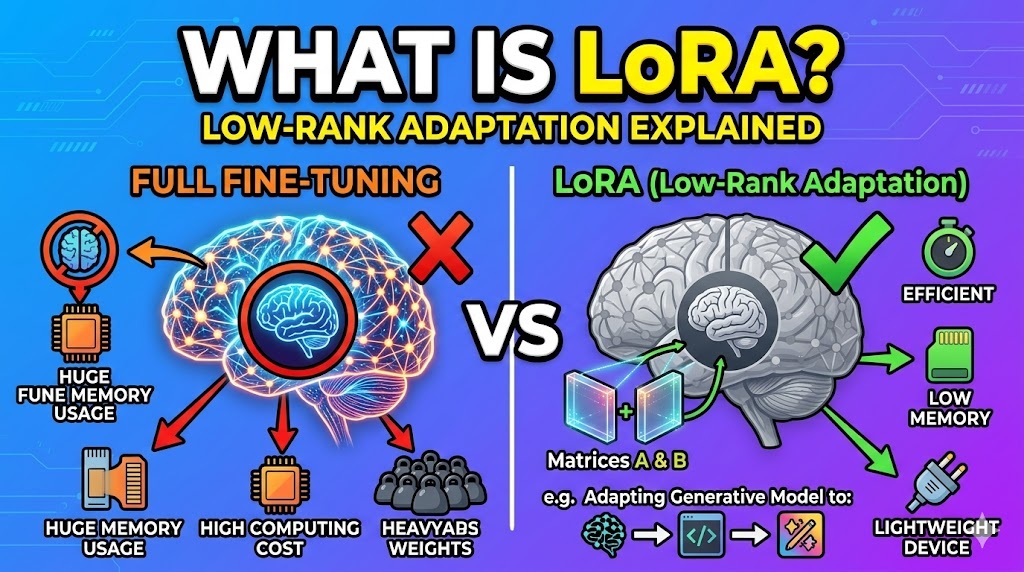
⚠️ The Problem: Full Fine-Tuning is Too Expensive
When you want to teach a pre-trained AI model a new skill (like writing Python code or adopting a specific tone), the traditional method is “full fine-tuning.” This means you adjust every single weight (parameter) in the model’s neural network.
🖥️ For modern LLMs, weight matrices are massive. If a model has 7 billion parameters, full fine-tuning requires loading all 7 billion weights into GPU memory, calculating gradients for all of them, and updating them. This requires multiple incredibly expensive GPUs.
✅ The Solution: LoRA
LoRA makes fine-tuning highly efficient by doing two things:
- 🧊 Freezes the original model: It locks the original, massive weight matrices of the pre-trained model so they cannot be changed. This immediately saves massive amounts of memory.
- 💉 Injects tiny “Rank Decomposition” matrices: Instead of altering the original weights, LoRA tracks the changes that need to be made using a parallel bypass pathway.
🧮 The Math: What does “Low-Rank” mean?
This concept can be tricky, but it boils down to basic matrix multiplication.
🔄 During training, a neural network updates its weight matrix $W$ by adding a matrix of changes, let’s call it $\Delta W$.
$$W_{new} = W + \Delta W$$
📉 Instead of calculating a massive $\Delta W$ matrix that is the exact same size as $W$, LoRA relies on the hypothesis that the changes needed to learn a specific new task have a “low intrinsic rank.” This means the essential information can be compressed.
✂️ LoRA decomposes the massive $\Delta W$ matrix into two much smaller matrices, $A$ and $B$, where a small “rank” parameter ($r$) determines their size.
$$\Delta W = B \times A$$
📊 A Concrete Example
Imagine a single weight matrix $W$ in a neural network that has dimensions of 10,000 x 10,000.
🔴 Scenario A: Full Fine-Tuning
- You must update the entire 10,000 x 10,000 matrix.
- Total trainable parameters: 100,000,000 (100 million).
🟢 Scenario B: LoRA
- You freeze $W$. You introduce LoRA with a rank of $r = 8$.
- Matrix $A$ has dimensions 10,000 x 8. (Total: 80,000 parameters)
- Matrix $B$ has dimensions 8 x 10,000. (Total: 80,000 parameters)
- Total trainable parameters ($A + B$): 160,000.
🚀 By using LoRA, you achieve nearly the exact same performance as full fine-tuning while only training 0.16% of the parameters.
📚 The Encyclopedia Analogy
Think of a pre-trained LLM as a massive, 100-volume encyclopedia.
- 📖 Full Fine-Tuning: You want to update the encyclopedia for a new medical discovery. You rewrite and reprint every single volume. It’s wildly expensive and takes forever.
- 📝 LoRA: You leave the encyclopedia exactly as it is (frozen). Instead, you write a tiny, 5-page “addendum booklet” (the low-rank matrices) that contains the specific medical updates. When someone looks up a topic, they check the encyclopedia, then quickly check the booklet for any overrides.
⚡ When training is done, you can even mathematically merge the small LoRA matrices back into the original model, meaning there is zero speed penalty when users actually run the model.
🖩 Below is an interactive calculator to help you visualize exactly how much memory you save by adjusting the rank ($r$) of a LoRA adapter compared to full fine-tuning.
🧠 LoRA (లో-ర్యాంక్ అడాప్టేషన్) అనేది లార్జ్ లాంగ్వేజ్ మోడల్స్ (LLMs) మరియు ఇతర భారీ న్యూరల్ నెట్వర్క్లను కంప్యూటేషనల్ వనరుల పరంగా ఎక్కువ ఖర్చు లేకుండా ఫైన్-ట్యూన్ చేయడానికి ఉపయోగించే అత్యంత ప్రసిద్ధమైన మరియు ప్రభావవంతమైన సాంకేతికత.
💡 LoRA ను అర్థం చేసుకోవడానికి, అది పరిష్కరించడానికి రూపొందించబడిన భారీ అడ్డంకిని అర్థం చేసుకోవడం సహాయపడుతుంది.
⚠️ సమస్య: పూర్తి ఫైన్-ట్యూనింగ్ చాలా ఖరీదైనది
మీరు ముందుగా శిక్షణ పొందిన (pre-trained) AI మోడల్కు కొత్త నైపుణ్యాన్ని (పైథాన్ కోడ్ రాయడం లేదా నిర్దిష్ట స్వరాన్ని అలవర్చుకోవడం వంటివి) నేర్పించాలనుకున్నప్పుడు, సాంప్రదాయ పద్ధతి “పూర్తి ఫైన్-ట్యూనింగ్ (full fine-tuning).” అంటే మోడల్ యొక్క న్యూరల్ నెట్వర్క్లోని ప్రతి ఒక్క వెయిట్ను (పారామీటర్ను) మీరు సర్దుబాటు చేస్తారు.
🖥️ ఆధునిక LLMల కోసం, వెయిట్ మ్యాట్రిక్లు (weight matrices) చాలా పెద్దవిగా ఉంటాయి. ఒక మోడల్ 7 బిలియన్ పారామితులను కలిగి ఉంటే, పూర్తి ఫైన్-ట్యూనింగ్ కోసం ఆ 7 బిలియన్ల వెయిట్లను GPU మెమరీలోకి లోడ్ చేయడం, వాటన్నింటికీ గ్రేడియంట్లను లెక్కించడం మరియు వాటిని అప్డేట్ చేయడం అవసరం. దీనికి చాలా ఖరీదైన బహుళ GPUలు అవసరం.
✅ పరిష్కారం: LoRA
LoRA రెండు పనులు చేయడం ద్వారా ఫైన్-ట్యూనింగ్ను అత్యంత సమర్థవంతంగా చేస్తుంది:
- 🧊 అసలు మోడల్ను ఫ్రీజ్ చేస్తుంది: ఇది ముందుగా శిక్షణ పొందిన మోడల్ యొక్క అసలైన, భారీ వెయిట్ మ్యాట్రిక్లను మార్చకుండా లాక్ చేస్తుంది. ఇది తక్షణమే భారీ మొత్తంలో మెమరీని ఆదా చేస్తుంది.
- 💉 చిన్న “ర్యాంక్ డికంపోజిషన్” (Rank Decomposition) మ్యాట్రిక్లను ప్రవేశపెడుతుంది: అసలైన వెయిట్లను మార్చడానికి బదులుగా, సమాంతర బైపాస్ మార్గాన్ని ఉపయోగించి చేయాల్సిన మార్పులను LoRA ట్రాక్ చేస్తుంది.
🧮 గణితం: “లో-ర్యాంక్ (Low-Rank)” అంటే ఏమిటి?
ఈ కాన్సెప్ట్ కొంచెం క్లిష్టంగా అనిపించవచ్చు, కానీ ఇది ప్రాథమిక మ్యాట్రిక్స్ గుణకారంపై (matrix multiplication) ఆధారపడి ఉంటుంది.
🔄 శిక్షణ సమయంలో, ఒక న్యూరల్ నెట్వర్క్ తన వెయిట్ మ్యాట్రిక్స్ $W$ కు మార్పుల మ్యాట్రిక్స్ను (దీనిని $\Delta W$ అనుకుందాం) జోడించడం ద్వారా అప్డేట్ అవుతుంది.
$$W_{new} = W + \Delta W$$
📉 $W$ తో సమానమైన పరిమాణంలో ఉండే భారీ $\Delta W$ మ్యాట్రిక్స్ను లెక్కించడానికి బదులుగా, కొత్త టాస్క్ను నేర్చుకోవడానికి అవసరమైన మార్పులు “తక్కువ అంతర్గత ర్యాంక్ (low intrinsic rank)” కలిగి ఉంటాయనే పరికల్పనపై LoRA ఆధారపడుతుంది. అంటే అవసరమైన సమాచారాన్ని కంప్రెస్ చేయవచ్చు.
✂️ LoRA భారీ $\Delta W$ మ్యాట్రిక్స్ను $A$ మరియు $B$ అనే రెండు చాలా చిన్న మ్యాట్రిక్లుగా విభజిస్తుంది, ఇక్కడ ఒక చిన్న “ర్యాంక్ (rank)” పారామీటర్ ($r$) వాటి పరిమాణాన్ని నిర్దేశిస్తుంది.
$$\Delta W = B \times A$$
📊 ఒక నిర్దిష్ట ఉదాహరణ
న్యూరల్ నెట్వర్క్లో 10,000 x 10,000 కొలతలు కలిగిన ఒకే వెయిట్ మ్యాట్రిక్స్ $W$ ఉందని ఊహించుకోండి.
🔴 సన్నివేశం A: పూర్తి ఫైన్-ట్యూనింగ్
- మీరు మొత్తం 10,000 x 10,000 మ్యాట్రిక్స్ను అప్డేట్ చేయాలి.
- శిక్షణ ఇవ్వాల్సిన మొత్తం పారామితులు (Total trainable parameters): 100,000,000 (100 మిలియన్లు).
🟢 సన్నివేశం B: LoRA
- మీరు $W$ ను ఫ్రీజ్ చేస్తారు. మీరు $r = 8$ ర్యాంక్తో LoRA ను ప్రవేశపెడతారు.
- మ్యాట్రిక్స్ $A$ కొలతలు 10,000 x 8. (మొత్తం: 80,000 పారామితులు)
- మ్యాట్రిక్స్ $B$ కొలతలు 8 x 10,000. (మొత్తం: 80,000 పారామితులు)
- శిక్షణ ఇవ్వాల్సిన మొత్తం పారామితులు ($A + B$): 160,000.
🚀 LoRA ను ఉపయోగించడం ద్వారా, మీరు కేవలం 0.16% పారామితులకు మాత్రమే శిక్షణ ఇచ్చి పూర్తి ఫైన్-ట్యూనింగ్ తో సమానమైన పనితీరును సాధిస్తారు.
📚 ఎన్సైక్లోపీడియా ఉదాహరణ
ముందుగా శిక్షణ పొందిన LLM ను 100-సంపుటాల భారీ ఎన్సైక్లోపీడియాగా భావించండి.
- 📖 పూర్తి ఫైన్-ట్యూనింగ్: మీరు ఒక కొత్త వైద్య ఆవిష్కరణ కోసం ఎన్సైక్లోపీడియాను అప్డేట్ చేయాలనుకుంటున్నారు. మీరు ప్రతి సంపుటాన్ని తిరిగి వ్రాసి ప్రింట్ చేస్తారు. ఇది చాలా ఖరీదైనది మరియు ఎప్పటికీ పూర్తవదు.
- 📝 LoRA: మీరు ఎన్సైక్లోపీడియాను ఉన్నది ఉన్నట్లుగానే (ఫ్రీజ్ చేసి) వదిలేస్తారు. బదులుగా, మీరు నిర్దిష్ట వైద్య అప్డేట్లను కలిగి ఉన్న 5 పేజీల చిన్న “అనుబంధ బుక్లెట్ (addendum booklet)” (లో-ర్యాంక్ మ్యాట్రిక్స్) వ్రాస్తారు. ఎవరైనా ఒక అంశం కోసం వెతికినప్పుడు, వారు ఎన్సైక్లోపీడియాను తనిఖీ చేసి, ఆపై ఏవైనా మార్పుల కోసం బుక్లెట్ను త్వరగా తనిఖీ చేస్తారు.
⚡ శిక్షణ పూర్తయిన తర్వాత, మీరు చిన్న LoRA మ్యాట్రిక్లను గణితశాస్త్రపరంగా తిరిగి అసలు మోడల్లో విలీనం చేయవచ్చు (merge), అంటే వినియోగదారులు వాస్తవంగా మోడల్ను రన్ చేసినప్పుడు వేగం పరంగా ఎటువంటి పెనాల్టీ (ఆలస్యం) ఉండదు.
🖩 పూర్తి ఫైన్-ట్యూనింగ్తో పోలిస్తే LoRA ఎడాప్టర్ యొక్క ర్యాంక్ను ($r$) సర్దుబాటు చేయడం ద్వారా మీరు ఎంత మెమరీని ఆదా చేస్తారో ఖచ్చితంగా దృశ్యమానం చేయడంలో మీకు సహాయపడే ఇంటరాక్టివ్ కాలిక్యులేటర్ క్రింద ఇవ్వబడింది.