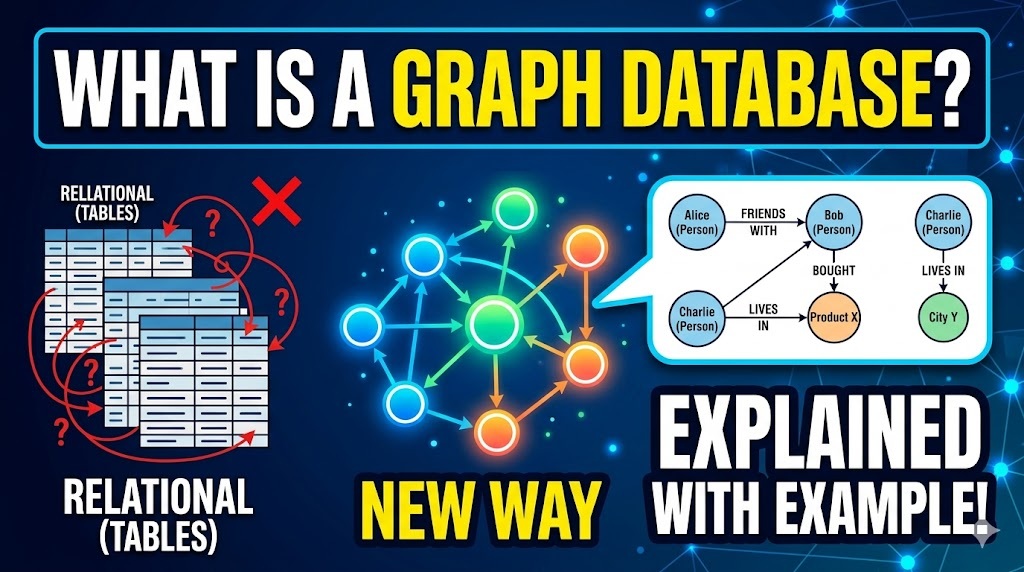
A Graph Database is a type of NoSQL database that uses graph structures to represent and store data. Unlike traditional relational databases that rely on rigid tables, graph databases prioritize the relationships between data points.
💡 Core Philosophy: In a graph database, the connections between data are just as important as the data itself.
🛠️ Key Components
🔵 Nodes (Vertices): These represent entities or objects.
Examples: A “Person,” “Product,” or “City.”
Analogy: Equivalent to a row in a relational database.
🔗 Edges (Relationships): These are the lines that connect nodes.
Function: They define how entities are related (e.g., “Follows,” “Bought,” or “Lives In”).
Details: Edges always have a start node, an end node, and a direction.
🏷️ Properties: These are key-value pairs used to store information about nodes or edges.
Example: A “Person” node might have name: "Alice" and age: 30.
📱 Real-World Example: Social Media Network
Imagine building a network like LinkedIn or Facebook.
The Setup:
👤 User A: Alice (lives in New York)
👤 User B: Bob (lives in San Francisco)
👤 User C: Charlie (lives in New York)
🏢 Company: TechCorp
The Relationships (Edges):
Alice 🤝 IS_FRIENDS_WITH ➡️ Bob
Bob 🤝 IS_FRIENDS_WITH ➡️ Charlie
Alice 💼 WORKS_AT ➡️ TechCorp
The Query Logic:
To suggest Charlie as a friend to Alice, the engine starts at the Alice node, traverses the IS_FRIENDS_WITH edge to Bob, and follows Bob’s connections to find Charlie. Because these links are physically stored, this “traversal” is instantaneous—even with millions of users! ⚡
⚖️ Relational (SQL) vs. Graph Database
Feature
🧱 Relational (SQL)
🕸️ Graph Database
Data Model
Rigid tables and schemas.
Flexible, evolving network.
Relationships
Calculated via JOINs at runtime.
Pre-stored and ready to traverse.
Best For
Transactional data (Accounting).
Connected data (AI, Social).
Performance
Slows down as links increase.
High speed regardless of depth.
🚀 Common Use Cases
🔍 Fraud Detection: Identifying complex patterns where different “customers” share the same phone number or IP address.
🛍️ Recommendation Engines: Suggesting products based on the “web” of what similar users bought.
🧠 Knowledge Graphs: Mapping intricate information, like Google’s search results or Wikipedia connections.
🕸️ Graph Database (గ్రాఫ్ డేటాబేస్)
Graph Database అనేది ఒక రకమైన NoSQL database. ఇది డేటాను రిప్రజెంట్ చేయడానికి మరియు స్టోర్ చేయడానికి graph structures (nodes, edges, మరియు properties) ఉపయోగిస్తుంది. మామూలు relational databases (tables, rows, columns) లాగా కాకుండా, ఇక్కడ data points మధ్య ఉండే relationships కి ఎక్కువ ఇంపార్టెన్స్ ఉంటుంది.
💡 ముఖ్యమైన విషయం: Graph database లో డేటా ఎంత ముఖ్యమో, వాటి మధ్య ఉండే connections కూడా అంతే ముఖ్యం.
🛠️ Key Components (ప్రధాన భాగాలు)
🔵 Nodes (Vertices): ఇవి entities లేదా objects ని సూచిస్తాయి.
ఉదాహరణకు: ఒక “Person,” “Product,” లేదా “City.” ఇవి relational database లోని ఒక row తో సమానం.
🔗 Edges (Relationships): ఇవి nodes ని కలిపే లైన్స్. రెండు entities మధ్య రిలేషన్ ఎలా ఉందో ఇవి చెప్తాయి.
ఉదాహరణకు: “Follows,” “Bought,” లేదా “Lives In.” ప్రతి edge కి ఒక start node, end node మరియు ఒక direction ఉంటాయి.
🏷️ Properties: ఇవి nodes లేదా edges కి సంబంధించిన అదనపు సమాచారాన్ని (metadata) స్టోర్ చేసే key-value pairs.
ఉదాహరణకు: ఒక “Person” node కి name: "Alice" మరియు age: 30 అనే properties ఉండవచ్చు.
📱 Real-World Example: Social Media Network
మీరు LinkedIn లేదా Facebook లాంటి ఒక social network బిల్డ్ చేస్తున్నారని ఊహించుకోండి. Relational database లో “friends of friends” ని వెతకాలంటే చాలా tables ని కలిపి కాంప్లెక్స్ JOIN operations చేయాలి, ఇది చాలా స్లోగా ఉంటుంది. కానీ Graph database లో కేవలం lines (edges) ని ఫాలో అయితే సరిపోతుంది.
📍 The Setup:
👤 Nodes: Alice, Bob, మరియు Charlie.
🤝 Edges:
Alice ➡️ IS_FRIENDS_WITH ➡️ Bob.
Bob ➡️ IS_FRIENDS_WITH ➡️ Charlie.
Alice ➡️ WORKS_AT ➡️ TechCorp.
⚡ The Query Logic:
Alice కి Charlie ని ఫ్రెండ్ గా సజెస్ట్ చేయాలంటే, database engine Alice node దగ్గర స్టార్ట్ అయ్యి, Bob కి ఉన్న IS_FRIENDS_WITH ఎడ్జ్ ద్వారా Charlie ని ఈజీగా వెతుకుతుంది. ఈ రిలేషన్స్ ఇప్పటికే database లో స్టోర్ అయి ఉండటం వల్ల, మిలియన్ల యూజర్లు ఉన్నా సరే ఈ traversal చాలా వేగంగా జరుగుతుంది.
⚖️ Why Use a Graph Database?
Feature
🧱 Relational (SQL)
🕸️ Graph Database
Data Model
Rigid tables మరియు schemas.
Flexible మరియు మారుతున్న network.
Relationships
Runtime లో JOINs ద్వారా లెక్కించాలి.
ముందే స్టోర్ అయి ఉంటాయి (Ready to traverse).
Best For
Transactional data (Accounting).
Connected data (Fraud detection, AI).
Performance
డేటా పెరిగేకొద్దీ స్లో అవుతుంది.
ఎంత లోతుగా వెళ్లినా High performance ఉంటుంది.
🚀 Common Use Cases (ఉపయోగాలు)
🔍 Fraud Detection: వేర్వేరు కస్టమర్లు ఒకే phone number లేదా IP address ని వాడుతున్నారా అనే patterns ని కనిపెట్టడానికి.
🛍️ Recommendation Engines: “మీలాంటి ఇంట్రెస్ట్ ఉన్న వాళ్లు ఈ ప్రొడక్ట్స్ కూడా కొన్నారు” అని సజెస్ట్ చేయడానికి.
🧠 Knowledge Graphs: Google search results లేదా Wikipedia లాంటి చోట్ల ఉండే సంక్లిష్టమైన సమాచారాన్ని ఒకదానితో ఒకటి లింక్ చేయడానికి.
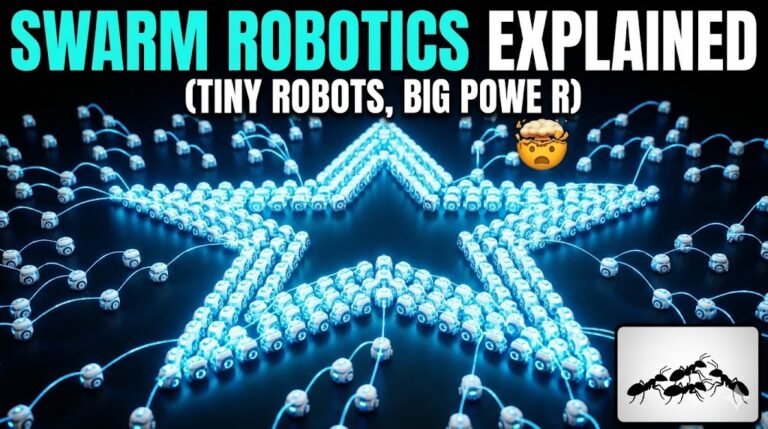
🤖 What is Swarm Robotics? Swarm robotics is a field of artificial intelligence and engineering where large numbers of relatively simple robots work together to achieve complex tasks. The concept is heavily inspired by biological systems—like 🐜 ant colonies, 🦅 flocks of birds, or 🐝 swarms of bees—where individual members follow basic rules, but their…
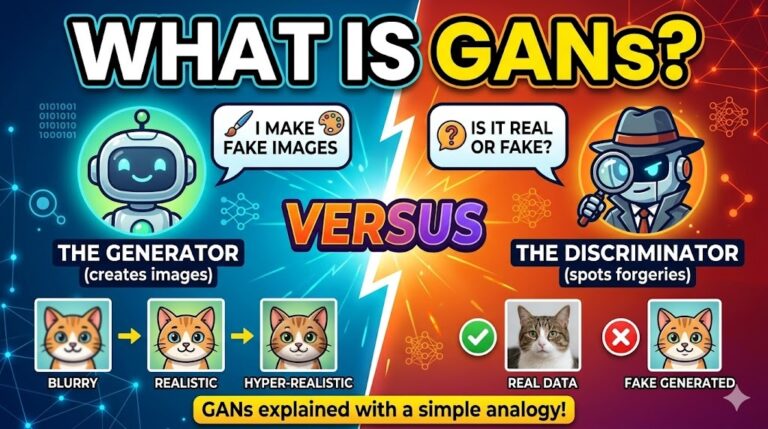
🧠 A Generative Adversarial Network (GAN) is a type of machine learning system where two artificial intelligence models compete against each other to create new, incredibly realistic synthetic data (like images, music, or text). ⚔️ The word “adversarial” is the key here. The system learns through competition. ⚙️ How GANs Work: The Two Competitors A…
Data in Generative AI: Structured Data vs. Unstructured Data – Complete Class Notes 1. Introduction to Data in Artificial Intelligence Data is one of the most important ingredients required to develop an Artificial Intelligence (AI) model. AI systems rely on data to identify patterns, learn relationships, generate predictions, and produce useful outputs. In this lesson,…
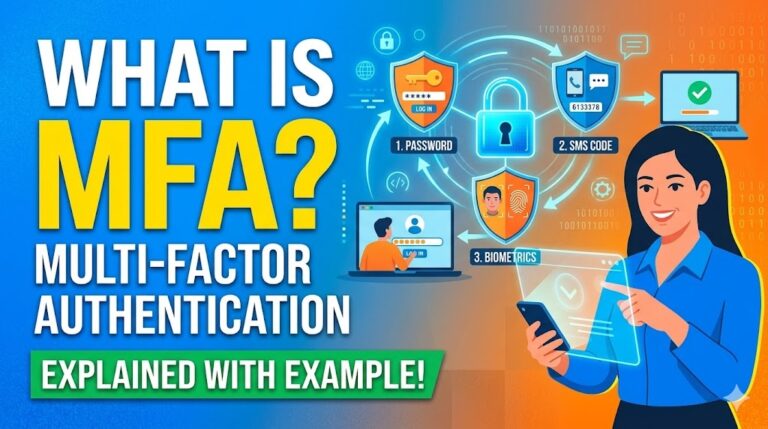
🛡️ What is Multi-Factor Authentication (MFA)? 🔒 Multi-Factor Authentication (MFA) is a security system that requires you to provide two or more different forms of identification before granting you access to an account, application, or device. 🚪 Think of it as adding extra deadbolts to your front door that require completely different types of keys…
Class Notes: Differentiating Tokenization, Sentiment Analysis, and Parsing Understanding how Natural Language Processing (NLP) interprets text requires distinguishing between three core processes: Tokenization, Sentiment Analysis, and Parsing. While they operate sequentially on the same text, each serves a distinct role in transitioning raw data into actionable, structured insights. Example 1: Customer Feedback Analysis Analyzing a…
🤖 What is SynthID? 🛡️ SynthID is a technology developed by Google DeepMind designed to watermark and identify AI-generated content. As generative AI becomes more advanced, it is getting much harder to tell what is real and what is created by a machine. 🧩 SynthID helps solve this by embedding a digital “signature” directly into…
 🚀 *Gen AI Engineer (Production Focused)*